The Hidden Staircase

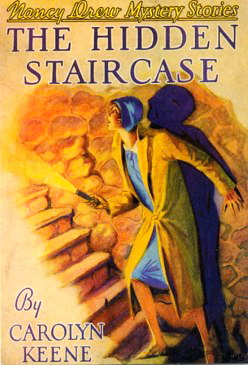
The Hidden Staircase by Carolyn Keene

1930

Illustrated by Russell Tandy

For anyone who has read the original editions of the early Nancy Drew mysteries, the lasting memory is of painful suspense.  Nancy Drew, alone at home at night, opens the door to a malevolent villain who threatens her with violence.  On a stormy eve, she breaks into her enemy’s sinister house; the cellar window bangs shut behind her, alerting the surly housekeeper who comes to investigate.  Locked in an upstairs bedroom, she finds the opening to the hidden underground passage, whose length she traverses with a flickering flashlight (that eventually fails), uncertain if she will encounter her nemesis in the rat-infested depths.  The ancient mansion in which she is staying has no phone and Nancy keeps her dangerous plans to herself, so there is a dread sense of isolation.

These scenes are from The Hidden Staircase, the second in the series.  There is a raw energy that is startling, beginning with the appearance of Nathan Gombet, tall and spindly like a “towering scarecrow”, with piercing eyes that repulse the young woman.  There is a Silence of the Lambs sinister quality to this character.  When Nancy happens into the room filled with his menacing taxidermied bird specimens (Hitchcock bestowed the same hobby on Norman Bates) along with live canaries in gilded cages, the sense of a deranged unpredictably violent character is complete.  There are the gothic atmospherics, from the architecture to the weather (always stormy, always night), and the queer happenings intended to frighten the elderly sisters into selling their family home – an infestation of flies, shadow figures on the walls, the disappearance of three black silk dresses.

il_fullxfull.290069581These touches came from the imagination of Mildred Wirt Benson, a woman from Iowa who was hired by the Stratemeyer Syndicate (creators of the Hardy Boys and the Bobbsey Twins, among many others) to ghostwrite the Nancy Drew mysteries under the pseudonym of Carolyn Keene:  she received $125 per volume in exchange for a vow of silence.  She wrote most of the volumes published from 1930 to 1953, but her role remained hidden until she testified in a court case between publishing houses in 1980.  Edward Stratemeyer created the series, but Benson gave life to the character who was to fire the imagination of generations of girls – the attractive blond amateur sleuth in her blue roadster, seeking justice for the downtrodden with her chums, Bess and George, and her endlessly patient beau, Ned Nickerson.  The early Nancy Drew is feisty, courageous, determined, outspoken, capable, and invincible, and it is worth seeking her out.  In 1959, she underwent a transformation as the original volumes were condensed and rewritten.  The revised version of The Hidden Staircase, which is the yellow-spined volume found in most book stores and libraries, is pallid, spiceless, and two-dimensional.  Gone is the colorful accomplice: “’You git, white man!’ she ordered, ‘or I’ll fill yo’ system full of lead.’”  Gone is the incompetent sheriff who inspires Nancy’s sarcastic disdain.  Gone is the frightening villain, replaced by a short stooped man who has no interest in taxidermy.  And because Nancy Drew is no longer alone at moments of danger, gone is the suspense.

The Hidden Staircase was Mildred Wirt Benson’s favorite.  Facsimile editions that reproduce the original 1930 volume are available, as are countless pre-1959 used copies.


christmas memory

A Christmas Memory and The Thanksgiving Visitor

A Christmas Memory by Truman Capote

1956

The Thanksgiving Visitor by Truman Capote

1967

Illustrated by Beth Peck

The creator of Holly Golightly, the worldly yet innocent gamine of Breakfast at Tiffany’s, immortalized another childlike character in two autobiographical holiday stories.  Truman Capote, born in New Orleans to a very young mother, was sent as a small boy to live in an eccentric household of elderly cousins in small town Alabama.  The youngest of these, a woman in her 60’s, became his closest friend.  Miss Sook was not quite of this world – she had never traveled more than five miles from home and had never read beyond the comics and the Bible – but she had the quiet dispassionate wisdom of the outsider.  Buddy, as she called the forsaken boy, was also someone who did not belong – he was a pretty boy who spent time reading and took up writing as a serious pursuit while in primer school.  In their separate loneliness, they each found a kindred spirit in the other.

christmas memoryA Christmas Memory begins on a crisp November morning: “Oh my……it’s fruitcake weather.”  Miss Sook, Buddy, and their feisty rat terrier, Queenie, set off with a dilapidated wicker baby carriage to collect windfall pecans.  They count the coins in their fruitcake fund, gathered over the course of a year and hidden under a loose floorboard, and purchase the necessaries, including a bottle of moonshine from the giant Indian, Mr. Haha Jones.  The curious recipient list for the fruitcakes includes President Roosevelt, a California couple whose car had once broken down in front of the house, Baptist missionaries in Borneo.  They hunt for the perfect Christmas tree in the woods, trim it with homemade paper cutout ornaments, and make kites for one another, as they do every year.  They each obtain an innocent delight from their holiday traditions, conducted in their own shared world, a world apart.

thanksgiving visitorThe Thanksgiving Visitor introduces a character who shatters that shared world – for an afternoon.  Over Buddy’s objections, Miss Sook invites Odd Henderson, the school bully and Buddy’s nemesis, for their Thanksgiving feast.  Having witnessed his enemy pocketing a cameo broach, Buddy takes his revenge by revealing the thief at the dinner table.  In what ensues, Miss Sook displays the wisdom of Solomon, Odd achieves a humble dignity, and Buddy is disgraced, having committed the one unpardonable sin of deliberate cruelty.

Truman Capote cultivated notoriety: he was known for his glamour-seeking pursuit of celebrity, his nasty penchant for scandalous gossip, his vituperative wit (most notoriously leveled at Gore Vidal with whom he had a much-publicized longstanding feud).  These two stories remind us of his more endearing (and enduring) qualities; clarity of prose style, pitch-perfect timing, and a poignant lyricism that is nowhere more apparent than in his memories of childhood.

The Wizard of Oz

The Wizard of Oz by L. Frank Baum

1900

Illustrated by Lisbeth Zwerger

Of the many beloved children’s books, none has been more embraced by American popular culture than The Wizard of Oz.  Originally published in 1900, the book’s phenomenal success launched a slew of sequels, prompted Hollywood to create one of the most-viewed movies of all time, and inspired a number of wildly popular Broadway musicals.  The yellow brick road, the ruby slippers (silver in the book), the Wicked Witch of the West, Judy Garland singing the impossibly beautiful Over the Rainbow – these are all familiar and enduring icons in the American vernacular.  In reading the book today, it is startling how fresh and modern it feels.  There is nothing old-fashioned or nostalgic that would suggest that it was written over a century ago.

L. Frank Baum was an impresario of sorts who threw himself into a bewildering sequence of professions, most without great success.  He finally discovered his genius as a storyteller.  His imaginative universe was fresh and light – revolutionary qualities in a genre that was dominated by the dark, Germanic, and moralistic.  He combined Midwestern realism (Kansas tornado, talking scarecrow) with old-world fairy tale elements (evil witches, protective kisses), a phantasmagoria of bizarre hallucinogenic characters (blue Munchkins, Winged Monkeys, armless Hammer-Heads) with optimistic 20th century psychology to create a unique species of magic.

Dorothy and her three companions, the Scarecrow, the Tin Woodman, and the Lion, take center stage in their quests for home, intelligence, heart, and courage.  But Baum’s most original and complex creation was the Wizard.  Stripped of his disguises, he turns out to be a meek and humble charlatan who is the victim of the world’s desire to be fooled.  “How can I help being a humbug,” he said, “when all these people make me do things that everybody knows can’t be done?”  Witness the willingness of the three seekers to suspend their disbelief long enough to acquire their missing qualities.  It should be noted that Baum had become a Theosophist only a few years before writing his first Oz book, and he cannot have been unaware of the charges of fakery leveled against Madame Blavatsky when she caused teacups to materialize and tables to levitate.

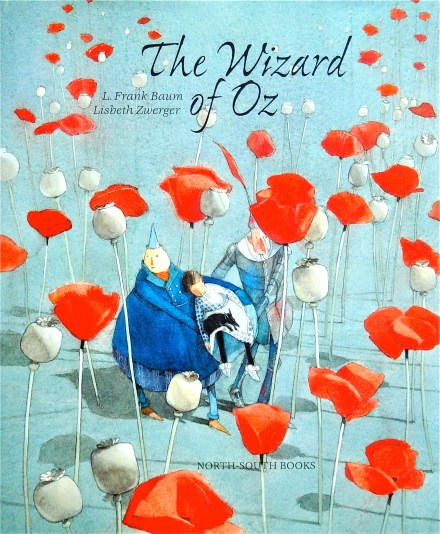
Of the many illustrators of The Wizard of Oz, Lisbeth Zwerger best captured the character of the humbug.  She draws him as an awkward perplexed mad scientist with wings of wired hair framing his bald pate.  His vulnerability and his chagrin at having been exposed as a conjuror are apparent.  Zwerger also does justice to the bizarreness and surrreality of Baum’s imagination – perhaps Dorothy was not the only one to be overcome by the fragrance of the red poppies.  To complete the experience, a pair of emerald-green tinted glasses, the cardboard decorated with occult sorcerer symbols, is secreted in the back of Zwerger’s editions, to be slipped on when Dorothy and her friends arrive at the Emerald City.

treasure island

Treasure Island

Treasure Island by Robert Louis Stevenson

1883

treasure island“Fifteen men on the dead man’s chest –

Yo-ho-ho and a bottle of rum!

Drink and the devil had done for the rest –

Yo-ho-ho and a bottle of rum!”

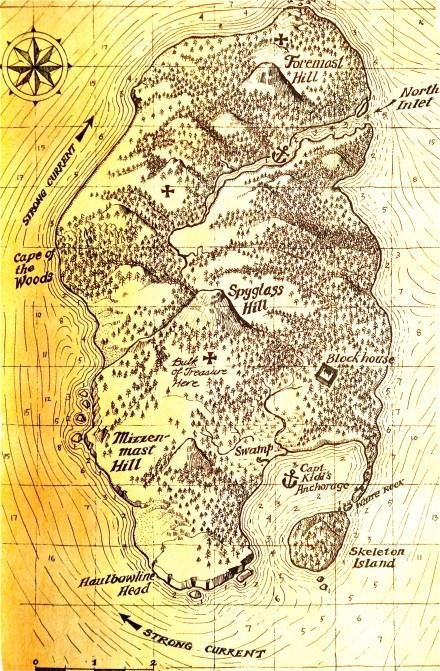
Inspired by a fanciful map drawn to amuse his step-son, Robert Louis Stevenson wrote Treasure Island, his first novel and his first work for children.  With its taut story-line and crisp prose, Treasure Island is a most suspenseful adventure tale.  Stevenson was adept at driving a plot, and what better components than a buried treasure and a mutinous crew of pirates outnumbering the virtuous by three to one?

More importantly, Stevenson was a master at creating character, and Treasure Island is really a book about Jim Hawkins and Long John Silver.  Jim, the narrator, is the young lad who finds the treasure map in the effects of the fierce buccaneer, Billy Bones, thus setting off the train of events.  He it is, through a series of rash decisions, who overhears the pirates’ mutinous plans, encounters the marooned Ben Gunn, and secrets the ship for later escape – all necessary to the salvation of his friends.  Long John Silver, alternately Jim’s nemesis and protector, is one of the most psychologically nuanced characters in fiction.  Ever mercurial, impressively astute, the one-legged pirate is charming and obsequious one moment and heartlessly cruel and treacherous the next.  (Fascinated by duality, Stevenson wrote The Strange Case of Dr. Jekyll and Mr. Hyde three years later.)  Even when at his most despicable, it is impossible not to admire his intuitive grasp of human nature and the ease with which he manipulates others to his advantage.  Against our reasoned judgment, we find him likeable and are relieved when Stevenson allows him to jump ship in a Spanish American port, together with a bag of gold and Cap’n Flint, his parrot, (squawking “Pieces of eight! Pieces of eight!”), thus saving his neck from the gallows.

Stevenson excelled at writing vivid description – witness his handling of the coracle, Ben Gunn’s goatskin teacup of a boat, dancing through the waves.  He also had a keen ear for dialogue.  Treasure Island is enhanced by a reader who can do justice to the dialects of the various voices, and this is even more true of Kidnapped, his other great adventure novel, in which the Scottish brogue is as key to the created atmosphere as the rich description of the highlands.

family sabbatical cover

Family Sabbatical

Family Sabbatical by Carol Ryrie Brink

1956

Illustrated by Susan Foster

Every book is a product of its times and Family Sabbatical is quintessentially 1950’s.  “”If I Russia, the Turkey might fall off the China into the Greece, causing loud Wales.  Abyssinia.’”  This is from George, the 10 year old middle child, who attempts to teach American colloquialisms (super duper, boy-o-boy) to Mademoiselle Beauregard, the dearly befuddled elderly governess.  The family is Midwestern, the children kind-hearted, and the humor literate and corny – a slice of ‘50’s Americana.


family sabbatical pg. 9

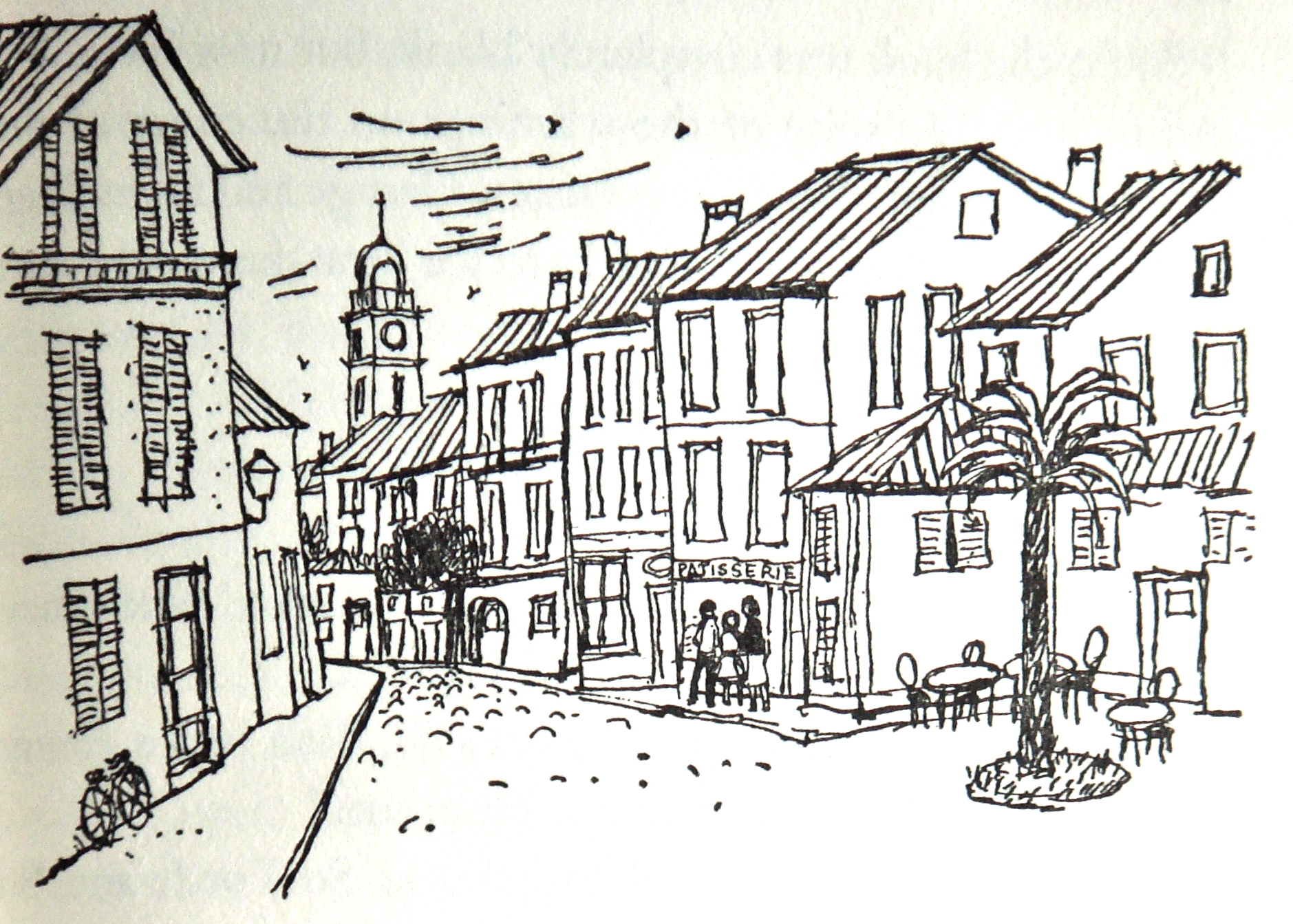
Yet it all takes place in France, initially in Cannes, later in Paris.  The Ridgeway’s are on sabbatical – the professor father is conducting historical research, the writer mother is working on a mystery, the three children are learning French.  Thirteen year old Susan is the capable/competent eldest, George is the naturalist and rock collector, and 7 year old Dumpling is the linchpin, precociously grounded with the wisdom of youth.  They live in the Grand Hotel Majestic et de l’Univers (known as the Grand Hotel and So Forth and So Forth), an edifice whose imposing name is insufficient to disguise aging decrepitude, eccentric bathrooms, and an erratically functioning gilt elevator.

But the second time they wanted to go up in the ascenseur, they saw that attached to the bird-cage door was a neat printed card which said: L’ASCENSEUR NE MARCHE PAS.

“But to marche means to walk,” said Susan, who was already learning some French.

“It means,” said Father, “that the elevator is not walking today.”

“But it means that we are,” said Mother.

Enter Mademoiselle Beauregard, the excitable spinster engaged to teach the children, a vehicle for the rich genre of humor that involves the French accent (think of what Peter Sellers as Inspector Clouseau was able to do with the words “room” and “phone”).  “Shorsh” delights in leading her astray – his greatest coup is inducing her to substitute “shut up” for “will you very kindly make a leetle more silence if you please”, an expression she innocently uses on the Father, to his horror.  Enter also Her Royal Highness, the Princess Adelaide Louisa von Mettnock-Hohenwurtzel (umlaut over the u), a fellow resident at the hotel, who turns out to be a kindly old woman rather than the golden-haired invalid that the children imagine.  Enter Mme. Ernestine DuChamel, quickly nicknamed the Earnest Camel, the proprietress of the Parisian private school in which the children are enrolled.  By the end of the first morning, Susan and George, with their rudimentary French, have been demoted to the first grade where they sit in tiny chairs alongside Dumpling.   Set off by these memorable characters, the American children experience the simple adventures of childhood, all tinted by the exoticism of French culture.

wolves of willoughby chase

The Wolves of Willoughby Chase

The Wolves of Willoughby Chase by Joan Aiken

1962

Illustrated by Pat Marriott

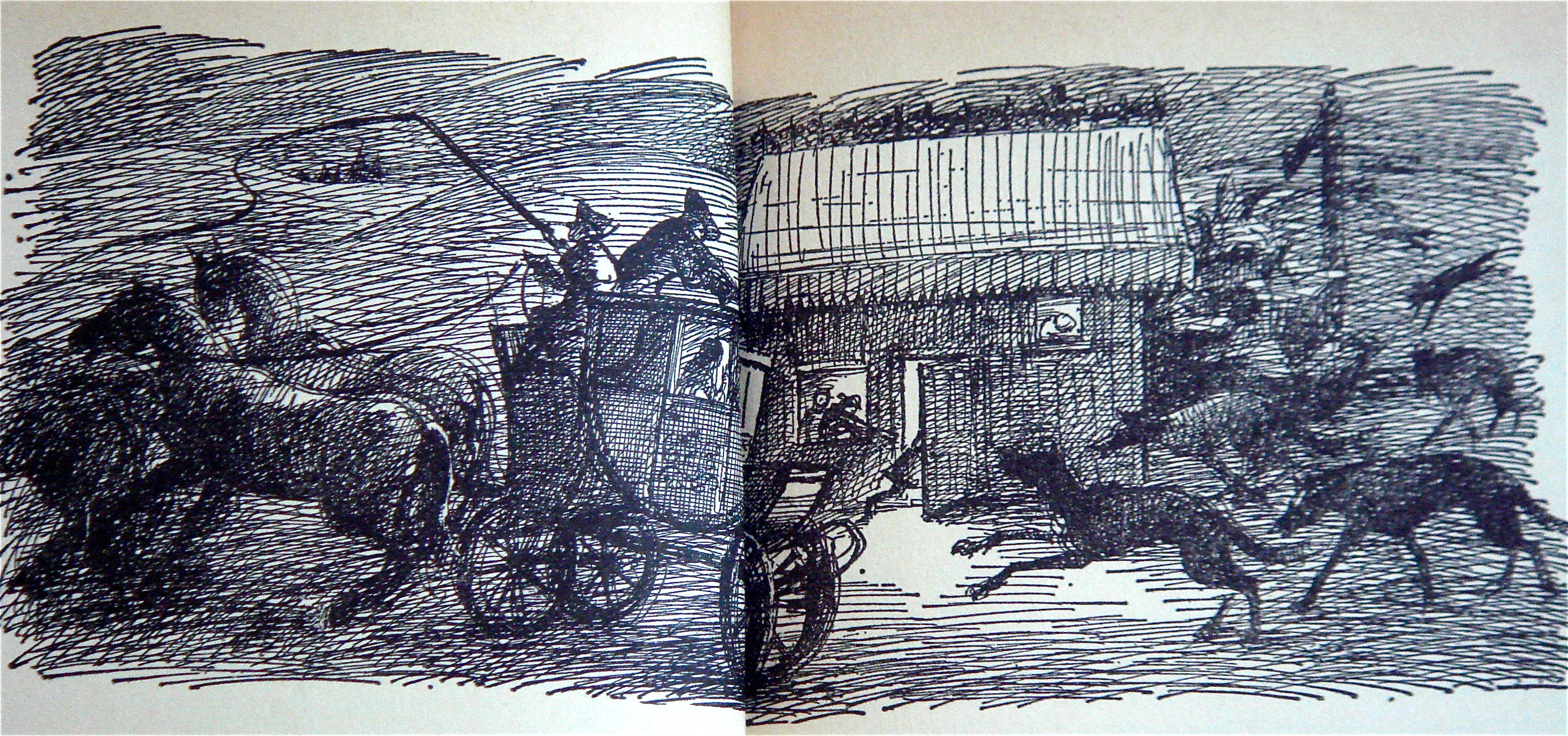
The fair-haired orphaned Sylvia leaves her aged Aunt Jane to live with her cousin Bonnie at the country estate known as Willoughby Chase.  On the overnight train journey, Sylvia is joined in her compartment by Josiah Grimshaw, a strange man who attempts to befriend her with chocolates and tea cakes.  When they are awakened by a lurching stop, Sylvia looks out on the frozen landscape to see wolves streaming across the snow.  They begin throwing themselves against the train window until the clasp gives, the glass shatters, and a wolf bounds into the compartment.  Mr. Grimshaw dispatches it with a shard of broken glass and then heaves its carcass out the window.

This singular scene, with a tone unlike that of any other book in children’s literature, gives a taste of Joan Aiken’s disorienting imagination.  The book is set in 19th century Britain but the improbable appearance of the sinister wolves reveals the backdrop to be pseudohistorical.  Aiken places her stories in the past, but she has taken liberties with history.  In a later book, we learn that the wolves have invaded England from the continent through a tunnel under the English Channel.  Aiken’s world is just a hair off-kilter, which makes it much more unsettling than a world of overt magic.

wolves of willoughby chaseWhen Sylvia reaches Willoughby Chase, she and Bonnie discover that Mr. Grimshaw is in league with the wicked Letitia Slighcarp, a distant relative in whose care the girls and the estate have been left during the absence of Sir Willoughby and Lady Green.  After sacking all the loyal retainers, Miss Slighcarp packs her charges off to an orphan work house in the bleak industrial town of Blastburn.  They make their escape from the cruel Mrs. Brisket with the aid of Simon, the forest boy who lives in an underground cave on the estate with his geese.  There is a wonderful scene in which the feverish Sylvia is tucked into a donkey cart with feather-filled mattress and quilts below and warm feathery geese on top.  Lulled by the soft warmth, she immediately falls asleep.

Joan Aiken came from a literary household – her father was the Pulitzer Prize winning Conrad Aiken and her stepfather was Martin Armstrong.  Home-schooled until the age of 12, she read voluminously as a child.  The influence of Charles Dickens is obvious in her work (note the names of the evil characters), as is that of Victor Hugo.  The wolves are borrowed from The Box of Delights, an unusual book by John Masefield that is little known in the U.S.  The starkly opposing forces of good and evil, with the inevitable triumph of the former, provide the makings of a gothic morality play or a wild melodrama (there are shades of both).  Aiken leavens the battle with a deadpan humor, sometimes with a morbid touch in the style of Edward Gorey (who provided the jacket illustrations for some editions).  For those intrigued by Aiken’s distinctive tone and strange imagination, there are a dozen books in the Wolves series alone.

danny the champion of the world

Danny the Champion of the World

Danny the Champion of the World by Roald Dahl

Illustrated by Quentin Blake

1975

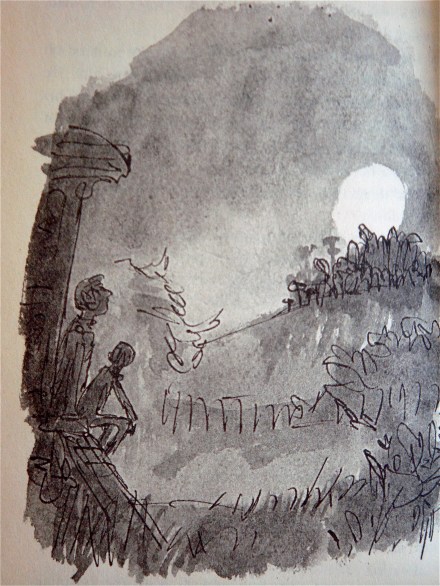
Danny lives with his father in an old painted gypsy caravan with built-in bunk beds, a wood-burning stove, and an apple tree out back.  His father, a car mechanic with an old-fashioned country filling station, is the perfect boyhood companion and the two have an idyllic life together tinkering on car engines, making kites, and launching tissue paper fire balloons on windless nights.  At the age of 9, Danny discovers that his father has a secret life – as a pheasant poacher in Mr. Victor Hazell’s woods, Mr Hazell being the arrogant and vulgar brewery owner and property baron of all the lands surrounding the filling station.  (“As he flashed by we would sometimes catch a glimpse of the great, glistening beery face above the wheel, pink as a ham, all soft and inflamed from drinking too much beer.”)  His father initiates Danny into the art of poaching by revealing his two pheasant-immobilizing methods, The Horsehair Stopper and The Sticky danny the champion of the worldHat, both based on the pheasants’ inordinate love of raisins.  Danny invents a new method, involving raisins laced with sleeping pill powder, and he and his father try it out the night before Mr. Hazell’s annual hunting party, thus thwarting his vain attempts to be accepted by the titled upper class.  Along the way, they receive help of various kinds from the kind Doc Spencer, the upright constable, the vicar’s wife, and the local taxi driver, all of whom turn out to be unlikely members of the poaching underworld.

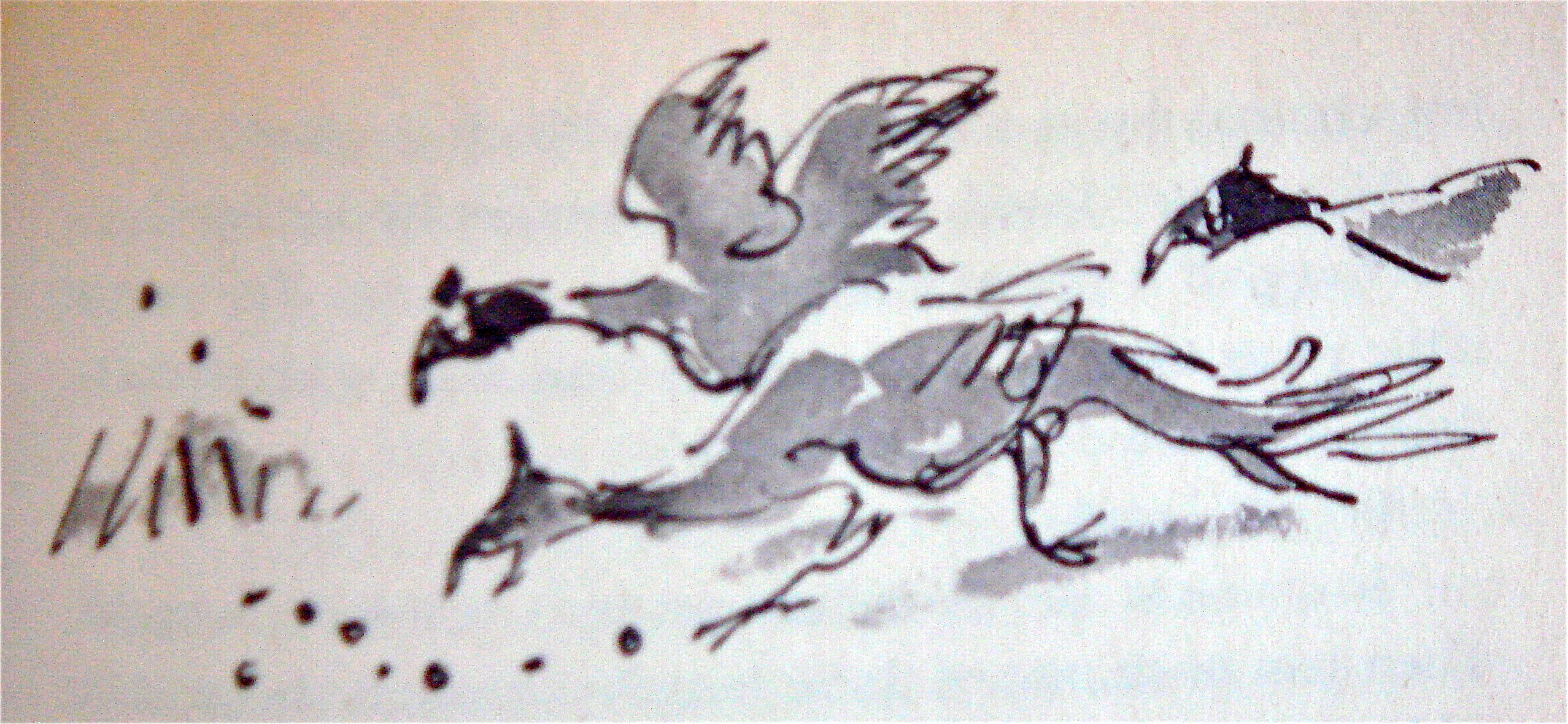
danny the champion of the worldOf all Roald Dahl’s books, Danny the Champion of the World is the gentlest.  It is suffused with the tender love that exists between Danny and his father, two figures drawn close since the death of Danny’s mother when he was four months old.  The book is unusual for being naturalistic – there are no witches, no giant peaches, no magical dream powders.  There are scenes that are as funny as any that exist in Dahl’s writing (witness the rising of the pheasants from the baby carriage as the effects of the sleeping pills wane), but he does not resort to the nonsense verse, silly naming, and general absurdities that are his usual stock in trade.

Roald Dahl was particularly fond of this story.  He originally wrote it as an adult short story that appeared first in the New Yorker in 1959 and subsequently in the collection, Kiss Kiss.  Although he made significant changes when he revised it for children, including the switch from two friends to a father and son, the basic plot line remained intact and whole passages were lifted verbatim from the story.  Dahl often reworked an idea – the genesis for The BFG came from a bedtime story told by Danny’s father about The Big Friendly Giant.

the house of sixty fathers book cover

The House of Sixty Fathers

The House of Sixty Fathers

by Meindert DeJong

Illustrated by Maurice Sendak

1957

In 1941, a group of American pilots volunteered for a clandestine operation to assist the Chinese Air Force defend against the Japanese invasion.  Under the command of the legendary Claire Lee Chennault, the Flying Tigers became populist heroes for their piloting daring-do, renegade spirit, and success despite unequal odds.  When the U.S. officially entered WWII after the attack on Pearl Harbor, Chennault’s mercenary group became the nucleus for the U.S. Air Force presence in China – the nickname and the hallmark shark mouth design that decorated the noses of the bomber planes were retained.  Meindert DeJong (pronounced DeYoung), a Dutch-American writer who was just beginning his career as a children’s author, joined Chennault’s forces in China as a military pilot and historian.  His outfit adopted a Chinese war orphan and DeJong tried unsuccessfully to bring the boy to the U.S.

This true story was the genesis for The House of Sixty Fathers.  Tien Pao, a young village boy, is separated from his parents and baby sister when his sampan is swept down the river into Japanese territory.  Accompanied only by his pig, Glory-of-the-Republic, he hides in tiny caves by day and travels through the mountains by night, reduced to eating leaves to stave off his hunger.  He saves the life of a downed American pilot and the two are befriended by Chinese guerrilla fighters who assist their escape from Japanese soldiers.  Tien Pao makes his way to the town where he last saw his family, only to find it under attack, its inhabitants fleeing in confusion.  He eventually finds refuge in the house of sixty fathers, the dormitory of the American bomber pilots, until his moving reunion with his parents.

from house of sixty fathersMeindert DeJong’s genius was his ability to convey the world through the eyes of his protagonist, whether that be a Dutch girl or a stray dog.  In this book, he views the complexity of wartime from the vantage of a Chinese peasant boy – the thrill of witnessing the routing of an advancing Japanese column by a solitary strafing plane alongside the horror of watching terror-stricken horses drowning, his disgust at a starving child eating mud along with the visceral joy of his first taste of chocolate, the selfish desperation of refugees throwing themselves upon a packed train along with the emotionless empathy of a soldier who plucks him from the crowd to safety.  With unflinching honesty, DeJong presents the fear, loneliness, and chaos of war along with the comfort of human companionship, the anchoring influence of family, and the reassurance of a pet, however porcine.  Both frightening and reassuring, this is one of the most powerful stories of wartime ever written for children.