lotties new beach towel

Lottie’s New Beach Towel

Lotties’s New Beach Towel by Petra Mathers

1998

Illustrated by Petra Mathers

Chickens tend to be cast as dithering ditzes, along the lines of Henny Penny and “the sky is falling.”  It is a sign of Petra Mather’s imaginative originality that her modest heroine, Lottie, is a hen.

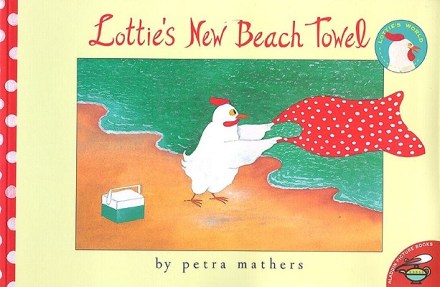
Lottie is squeezing lemons and making peanut butter and banana sandwiches when the mailman leaves a package from her Aunt Mattie.  She opens it to find a beach towel, red with white polka dots.  Picnic lunch and towel in hand, Lottie heads for the beach to meet Herbie for an outing in his boat.  The story is a simple day in the life, with the myriad uses of the towel (as an island refuge for sand scorched feet, as a sail for a dead engine, as a wedding veil for a bereft bride, as a shawl when night descends) as the binding thread.

With minimal text, a simple plot line, and colorful clean pictures, Petra Mathers creates two memorable characters who enjoy a gentle loving friendship.  Lottie, grounded and competent, leads a rich and creative life – she makes lemonade from lemons, knits socks for Herbie’s webbed feet (he is a duck), strikes up new friendships with the wedding party, composes a letter on her old fashioned typewriter.  Herbie, sporting a hat emblazoned “Capitano”, is a dear old salt who repeats silly jokes and relishes a good cake (or anything else that can be eaten).  Lottie is affectionate and gently mocking.  Herbie acknowledges his foibles sheepishly, sustained by her understanding.  They are both decent and tender hearted.

They are also comical.  Even when read a hundred times, children always laugh when Lottie mistakes a starfish for her foot (“Silly me.”)  They laugh when the motor dies (“I think it’s just tired,” said Herbie.  “I think it just went to sleep,” said Lottie.)  They laugh when Herbie is messily gluttonous (“I’m so hungry I don’t care if there is sand on my sandwich.  Get it, Lottie?”  “Yes, Herbie, and jelly on your belly.”)  The bright fresh watercolor illustrations add humor, beginning with Lottie whose red crest variously resembles a floppy water balloon, a beret, a windsock, or an exclamation point.

Petra Mathers has written and illustrated a number of other distinctive books, beginning with Maria Theresa, the story of a hen who flies the coop and joins a circus.  Theodor and Mr. Baldini, one of her most original stories, features a dog who begins to speak.  His first words – “Beef Bits again?”
Max’s Chocolate Chicken

Max’s Chocolate Chicken by Rosemary Wells

1989

Illustrated by Rosemary Wells

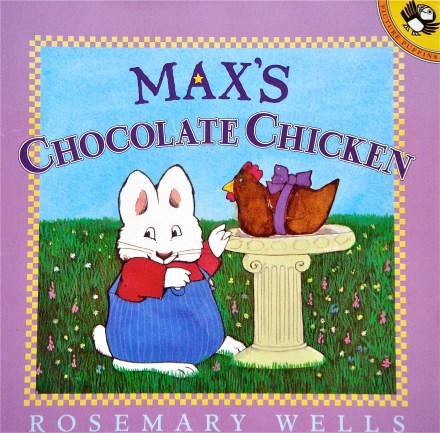
The book begins with an Easter bunny, in yellow paisley tails and purple vest, backed by a star studded sky, gliding low and gently dropping Easter eggs from his basket onto a grassy meadow.  He places a chocolate chicken, wrapped round with a pink ribbon, in an empty birdbath.  Max stares at the chicken with a look of weak-kneed rapture and proclaims his love.  Enter Ruby, his older sister, who interrupts his lovestruck revery to lay down the rules.  The Easter egg hunt is to be a competition.  Winner takes the chicken.  She admires each colorful egg she finds.  Max delights in floating his basket in a mud puddle, collecting acorns, following a trail of ants.  While Ruby, Midas-style, counts her eggs, Max slips away.  When he emerges from his hiding place, mouth covered with telltale chocolate, Ruby remonstrates.  “’Max……how could you do this to me?’”  Behind her back, we see the Easter Bunny’s hand slipping a chocolate duck onto the birdbath.  The book ends with Max’s protestation of love to a new object of desire (and we see that he has already broken off the tail).

max's chocolate chickenMax’s Chocolate Chicken is one in a series of over two dozen Max and Ruby books.  Ruby, usually well-intentioned, sometimes self-serving, tries to impose her agenda on her younger brother.  Indifferent to her priorities, Max always succeeds in following his own very different agenda, quietly making an end-run around his sister’s plans.  There is neither animosity nor rancor in their relationship.  There is much humor, however, as we watch Ruby persist, over and over, in her wrongheaded belief that she can prevail.

Rosemary Wells is a brilliant humorist, the best there is in the picture book world.  She learned what she needed to know about comedy and timing from Sid Caesar and Jackie Gleason.  Her touch is deft and fresh, subtle and intelligent.  Her amazing gift is the ability to appeal equally to children and adults – and the humor never stales, despite endless readings.  Who else can claim as much?  The storylines ring true (the siblings were based on the author’s daughters, Beezoo and Virginia), the writing is succinct and clever, and the illustrations create humor through minute shifts of mouth or eye that perfectly express characters’ feelings.

Max and Ruby are bunnies, but that is incidental.  With the notable exception of the white West Highland terrier who stars in the McDuff series, the world according to Rosemary Wells is filled with skunks, guinea pigs, raccoons, kitties, dogs, and ducks, all wearing clothes and behaving like people.

Aside:  “Drink your milk, Fritz,” said Fritz’s father.

           Fritz put a dab of relish in his milk

           so that it would turn a weird color.

           “Something’s wrong with it,” said Fritz.

                               (From Fritz and the Mess Fairy)

little bear

Little Bear

Little Bear by Else Holmelund Minarik

Illustrated by Maurice Sendak

1957

In 1957, two authors, independently, set out to write a book that could help young children learn to read.  Else Holmelund Minarik, a first grade teacher on Long Island, was prompted by the dearth of interesting books for early readers, her young daughter among them.  Dr. Seuss was given a list of 348 words by his publisher and challenged to do something with them.  The results were Little Bear and The Cat in the Hat, each written with a vocabulary of fewer than 250 mostly monosyllabic words.  It is remarkable that such a limited palette could be transformed into two such divergent reading experiences.  Dr. Seuss concocted a frenetic rhyming wonder about the Cat in the Hat and his kite-flying sidekicks, Thing 1 and Thing 2, who create havoc while the mother is away.  Else Minarik invented Little Bear, a lovable creature who enjoys the pleasures that come from the imagination, friendship (with Hen, Duck, and Cat), and a loving mother.  Both books have retained their popularity for more than half a century and children should be forever grateful that their publication spared future generations the robot-like tedium of the Dick and Jane primers in which nothing ever happened (“See Spot.  See Spot run.”)

Minarik’s gift was the creation of character with an economy of words, especially memorable in the figure of Mother Bear who is wryly humorous, playful, and reassuring.  When Little Bear makes himself a space helmet and declares his plan to fly to the moon like a bird, she responds with tolerant skepticism.

little bear

“And maybe,” said Mother Bear, “you are a little fat bear cub with no wings and  no feathers.

“Maybe if you jump up you will come down very fast, with a big plop.”

“Maybe,” said Little Bear.  “But I’m going now.  Just look for me up in the sky.”

“Be back for lunch,” said Mother.

When Little Bear wanders back, pretending in his mind that he is having a lunar experience, his mother greets him, “But who is this?  Are you a bear from Earth?”  And they enjoy the shared pretense until Little Bear decides it is time to resume his true persona so he can envelop himself in the arms of his real mother.

little bear's friendElse Minarik’s writing was paired with Maurice Sendak’s illustrations for Little Bear.  Both were immigrants, of sorts.  She came from Denmark at the age of four and imbued her books with her memories of an idyllic childhood in the old country.  He, the son of Polish immigrants, had a miserable growing-up in Brooklyn, steeped in tragic stories of shtetl persecution.  Sendak may have given vent to his personal demons in Where the Wild Things Are and In the Night Kitchen, but for Little Bear he got the tone just right for Minarik’s childhood eden.  The costumes are late 19th century with pinafores, bonnets, sweeping dresses, capes, and top hats – for everyone but Little Bear himself, who wears his own fur coat.  For the space helmet, Sendak devised an upended cardboard box with ear flaps and sprung coil antennae.  Sendak illustrated the first five in the Little Bear series (Little Bear, Father Bear Comes Home, Little Bear’s Friend, Little Bear’s Visit, and A Kiss for Little Bear) and it is best to stick with these.  Note in the last of them, Little Bear paints a picture of a Wild Thing as a gift for his grandmother.

punch in new york

Punch in New York

Punch in New York by Alice Provensen

Illustrated by Alice Provensen

1991

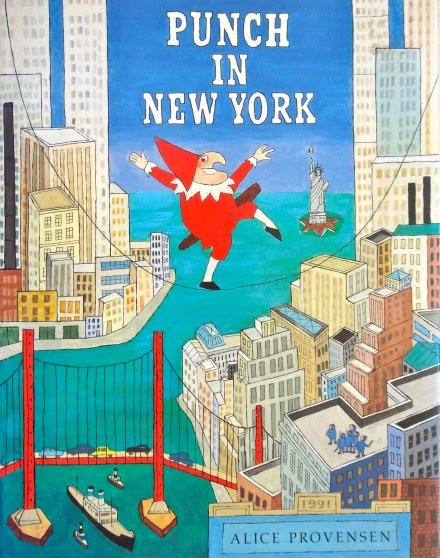
Of all the picture books for children, this is one of the most exhilarating to read aloud.  Just look at the cover.  The main character, looking “pleased as Punch”, tiptoes across a trapeze line suspended slackly over the New York skyline while a group of cops stare impotently up at him from a rooftop below.  He looks at us out of the corner of an eye, his smile gleeful, his pointy toe poised for the next step.  He is on top of the world, ready for his next audacious act, secure that he will triumph over the forces of law and order.

Let’s look at the plot.  The Professore Tucci-Piccini, (pronounced, as he explains, “Too-chee Peach-eeny”), has just arrived at JFK, Punch and Judy cast in hand, when the suitcase holding his star puppet is snatched by a thief.  Disgusted that their heist turns out to be a doll, the gang of robbers tosses Punch out the window.  He survives the 40 story fall, taking out a window washer and a wedding cake on the way down.  Upon landing, he is off and running in the streets of Manhattan, where he has a series of antic encounters with a seat stealer, a hot dog vender, a policeman, and a crocodile.  Manipulating a trio of muggers into waylaying a chauffeur, Punch slides into the driver’s seat of the Rolls Royce of Mr. Helmstrump, the world’s richest man.  He drives over a police car and a bus before getting snagged by a crane and flung over the rooftops until he lands with a bump in front of the Russian Tea Room, taking the awning down with him.  “’No tea today, thank you, James,’ says Mr. Helmstrump.”  With cushy job in hand, Punch finds the Professore and his cast performing in Central Park, and they join him for the fat life.

Alice Provensen dishes up a witty take on the classic anti-hero.  In the typical Punch and Judy show, as performed by Giovanni Piccini, a famous “professor” (as the puppeteers were known) some 200 years ago in London, Punch tosses his baby out the window and proceeds to kill off a whole cast of characters, beginning with his shrewish wife and ending with the devil.  Provensen makes a few adjustments and gives us a trickster who is easy to like.  She lets him wield his stick at Joey the Nasty Man, who surely deserves some punishment, but she has a manhole crocodile (another stock character in the Punch and Judy firmament) chomp the pursuing cop.  She lets Punch spray paint graffiti on the Rolls, but we laugh because “Stupid” is an intrinsically funny word.  And who would begrudge Punch for taking advantage of Mr. Helmstrump (any New Yorker would recognize the nod to the Trump and Helmsley empires in the illustrations)?  Provensen, ever young with her crisp ironic sense of humor, wrote Punch in New York in her seventies.  Over a 50+ year award winning career, she wrote and/or illustrated (either solo or with her husband, Martin, until his death) dozens of distinctive books.  Try Our Animal Friends at Maple Hill Farm or A Day in the Life of Murphy for a taste.

the man who walked between the towersAside:  There is another book with a high wire act over New York on the cover, The Man Who Walked Between the Towers by Mordicai Gerstein.  In 1974, the French trapeze artist, Philippe Petit, in an audacious act of guerilla performance art, strung a wire between the twin towers and proceeded to dance for an hour to the amazement of the onlookers on the sidewalks far below and the grudging respect of the cops waiting with their handcuffs.  This book, with its beautiful cover illustration, tells the tale.