Goodnight Moon


goodnight moonGoodnight Moon by Margaret Wise Brown

1947

Illustrated by Clement Hurd

The creative genius of Margaret Wise Brown is nowhere more apparent than in Goodnight Moon. This beloved book begins, “In the great green room/ There was a telephone/ And a red balloon/ And a picture of –/ The cow jumping over the moon”.  After listing the contents of the room, each item is tucked away for the night, “Goodnight room/ Goodnight moon/ Goodnight cow jumping over the moon”.  In the vibrant illustrations by Clement Hurd, we see a bunny rabbit in blue and white striped pajamas in his bed in the green room surrounded by the objects listed in the story.  The old lady appears knitting in the rocking chair and then disappears.  Two kittens play with a ball of yarn and curl up together.  The mittens and socks dry by the fire.  A mouse scampers across the floor and ends up on a windowsill staring at the moon.  The lights dim and the bunny falls asleep.

goodnight moon

A spare 130 words, the book is a marvel of writerly restraint.  It contains considerable rhyming (“And a comb and a brush and a bowl full of mush/ And a quiet old lady who was whispering ‘hush’”), but Brown was no slave to poetic meter.  The result is a work of considerable sophistication with just enough dissonance and asymmetry to lend contrast to the soothing nursery rhyme cadences.

Margaret Wise Brown died at the age of 42.  While on a visit to France in 1952, she had a pulmonary embolus while recovering from surgery for an ovarian cyst.  In the settlement of her estate, the future royalties of Goodnight Moon were projected to be $500.  The beneficiary of these royalties was an 8 year old boy who lived in her neighborhood.  In fact, this book became one of the all time bestsellers of children’s literature.  It is a book that can be read hundreds of times as a bedtime ritual and never lose its freshness.

Aside:  On the wall of the green room is a framed painting which depicts a fishing rabbit.  This is an illustration from The Runaway Bunny, another book written by Brown and illustrated by Hurd.


Matilda

Matilda1 Matilda by Roald Dahl

1988

Illustrated by Quentin Blake

It would be unconscionable to let any child get through childhood without reading the Roald Dahl books.  James and the Giant Peach, Charlie and the Chocolate Factory, The BFG, The Witches – they all have the unmistakable slapstick humor, the silliness and nonsense, that Dahl loved to write and children love to read.  The nasty authority figures are morally horrific and physically repugnant.  Take Aunt Sponge, for example, with “one of those white flabby faces that looked exactly as though it has been boiled”, or George’s Grandma with her “small puckered-up mouth like a dog’s bottom”.  The child heroes and heroines, who tend to be quiet, selfless, unassuming, and patient, devise ingenious schemes to thwart their torturers and they invariably succeed.  The bullies of the world are vanquished: there is no redemption for the wicked.  Dahl has had many detractors among adults, who have decried the gruesome violence and retribution, the tastelessness, of his books.  While critics and teachers are arguing about his subversive influence, his child fans are sneaking off to a corner to delight in yet another of his very funny books.DSC01470

Matilda was Dahl’s last major book, the culmination of a prolific writing career that spanned five decades, and it reflects the hand of a master.  The memorable Matilda is a tiny, brilliant girl who is reading Great Expectations and The Sound and the Fury at the age of four.  When she requests books of her parents, her vulgar father, a crooked second hand car dealer prone to wearing loud check suits, and her mother, a vapid peroxide blond who plays bingo every afternoon, direct her indignantly to the telly.  When she begins kindergarten, she encounters her ultimate nemesis, Miss Trunchbull, the sadistic headmistress.  Enraged by their beastliness and the injustice of it all, Matilda devises clever punishments for each of her tormentors.  She is a particularly noble heroine, since she achieves justice not only for herself but for her teacher, Miss Honey, who has been intimidated into submission.

DSC01466It is impossible to read Roald Dahl without envisioning the accompanying illustrations by Quentin Blake.  The pen and ink drawings appear to have been hastily scribbled: they have a scratchy, energetic, cartoonish quality, (Blake has attributed influence to Honore Daumier), that is perfectly paired with the zaniness of Dahl’s writing.  Blake has illustrated a number of writers, including his own books, but his lasting legacy will be his collaboration with Roald Dahl.

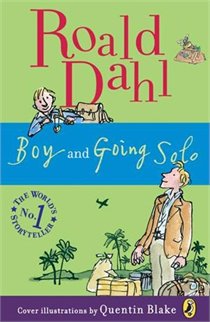
urlAside:  Avid Roald Dahl fans will enjoy his autobiographical duo, Boy and Going Solo.  In the former, he tells of dropping a dead mouse into the neighborhood candy shop’s Gobstopper jar to get back at the horrible Mrs. Pratchett.  He recalls the treat of newly invented Cadbury’s chocolate bars delivered to his boarding school for taste-testing, the genesis of Charlie and the Chocolate Factory.  The second book recounts his adventures with simbas and green mambas in Tanzania, and his dangerous missions as an RAF pilot in the early months of WWII.

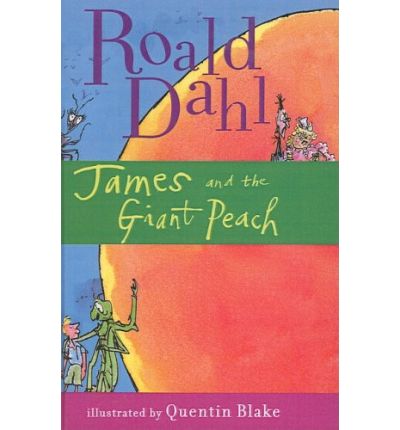
9781417786084Aside:  It is worth listening to Jeremy Irons read James and the Giant Peach to hear his spectacular voices for the enormously fat Aunt Sponge (rendered with a moist lisp) and the tall and bony Aunt Spiker.  Unfortunately for the listener, they meet their end, crushed flat by the rolling peach, a third of the way through the book.

A Stranger at Green Knowe

stranger at green knoweA Stranger at Green Knowe by Lucy Boston

1961

Illustrated by Peter Boston

Of the six books that comprise the Green Knowe chronicles, A Stranger at Green Knowe stands alone for its realism.  There are no elusive ghost children from the time of the Great Plague, no malevolent witches, no time traveling stone chairs.  There is just a boy and a gorilla.

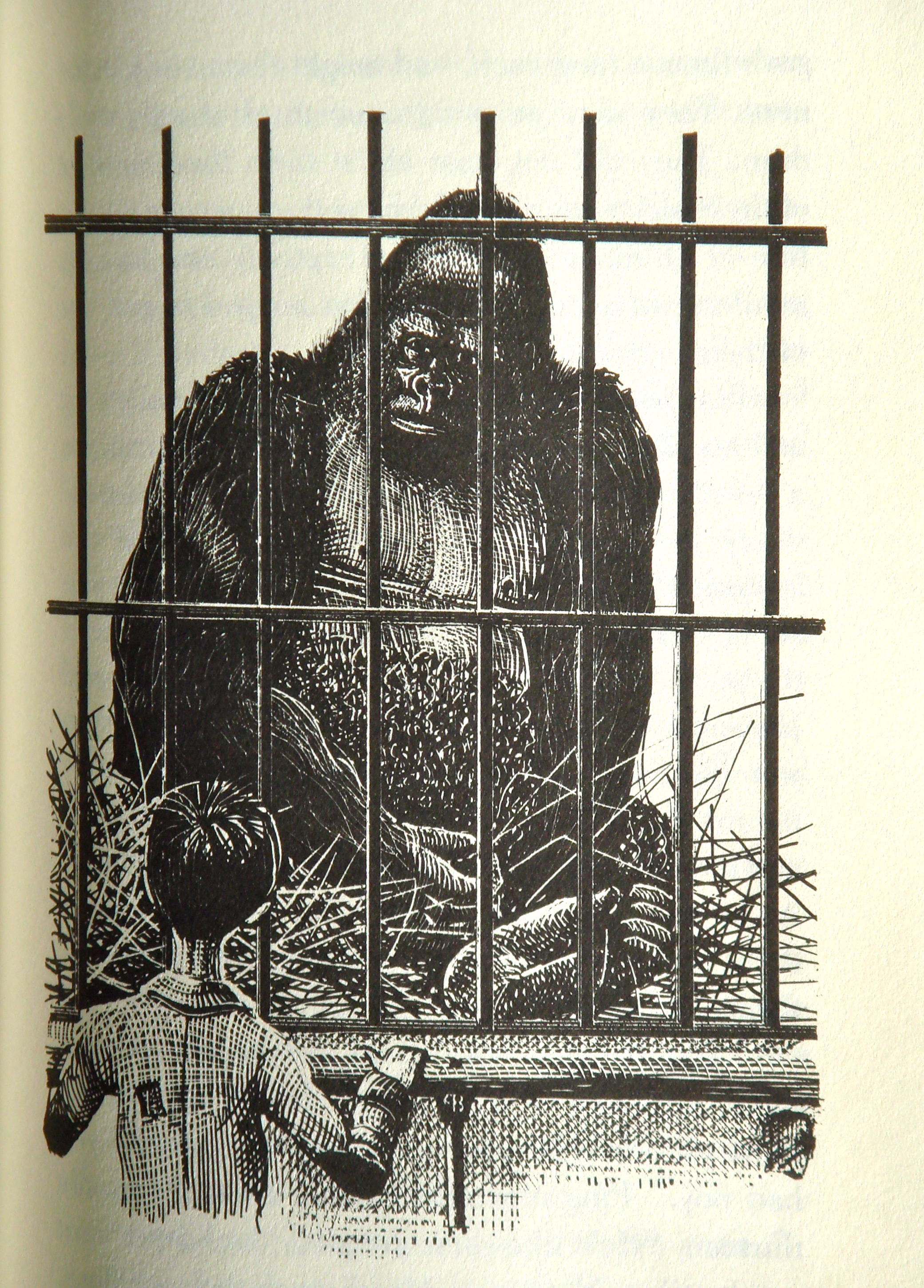
The extraordinary opening chapter stands at the pinnacle of atmospheric nature writing, and by itself justifies the award of the Carnegie Medal (the English equivalent of the Newbery Award).  Written from the point of view of a young gorilla, it describes the rhythm of life of a gorilla family in the tropical forest of the Congo.  Their world is abruptly shattered by a hunting party that kills the parents and captures the young male and his half-sister.  Hanno, as he is named by his captors, ends up in a London zoo.  The monkey house comes from an era of small square cages, concrete floors, and no attempted simulation of natural habitat – the only adornment is a small pile of straw.

stranger at green knoweThe story picks up 11 years later when Ping, a Chinese refugee, visits the zoo with his fellow school children and feels an immediate affinity for the imprisoned gorilla, an awe-inspiring force of nature constrained behind bars.  Their stories are analogous, for Ping’s childhood settlement in a Burmese forest was sacked and burned and his parents killed, and he himself has experienced the unyielding deadness of concrete in refugee camps.  Ping goes to spend the summer holidays with the elderly Mrs. Oldknow at Green Knowe and Hanno, escaped from the zoo, finds refuge in a bamboo thicket on the estate.  The boy surreptitiously aids the gorilla, secretly foraging for food in the vegetable garden, all the while anguishingly aware of the tightening noose of the pursuers.

Aside:  “Here in their ugly, empty cages the monkeys were no more tropical than a collection of London rats or dirty park pigeons.  They were degraded as in a slum.  Some sat frowning with empty eyes, and those that wasted their unbelievable grace of movement, in leaping from perch to chain, from chain to roof, from roof to perch to chain, repeating it forever, had reduced to fidgety clockwork the limitless ballet of the trees, which is vital joy.”

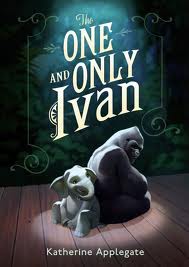
the one and only ivanAside:  For another tale of a gorilla in captivity, try The One and Only Ivan by Katherine Applegate, winner of the 2013 Newbery Award.

hey willy

Hey Willy, See the Pyramids

Hey Willy, See the Pyramids by Maira Kalman

1988

Illustrated by Maira Kalman


There are images that recur.  Identical twins, chickens, pompadours, fezes, pointed shoes, big hairdos, cloche hats, Bertoia wire chairs, black and white cross-lined suits that look like Bertoia chairs.  There are recurring characters.  Pete the dog, Max the beat poet, Aunt Rose, Maishel Shmelkin, Lulu, Alexander.  They may resurface in consecutive books or there may be a lapse of decades.  Many of the characters derive from life.  Take Lulu and Alexander.  They are Maira Kalman’s children, once young, later grown.  There is a highly personal narrative that runs as a linking thread throughout.

 hey willy

The books began in 1985 with Staying Up Late, a collaboration with David Byrne.  The lyrics of the Talking Heads song form the text, and the best way to read this book is to listen to the song while turning the pages.  A dozen children’s books followed, half with Max or Pete as dog protagonists.  They are variously set in Japan, Paris, Hollywood, and India but the home city is clearly New York.  Witness Next Stop Grand Central or Roarr, Calder’s Circus (which can be seen, the circus that is, at the Whitney Museum).  The most moving is Kalman’s tribute to the twin towers tragedy, Fireboat: the Heroic Adventure of the John J. Harvey, which tells about a 1931 fireboat, once destined for the scrap yard, that came back into service when the World Trade Center burned.

Then there is the work intended for adults.  A monthly blog for the New York Times that loosely explored the big philosophical questions (the meaning of life, the inevitability of death) was published as a chapbook, The Principles of Uncertainty.  A chance garage sale encounter with Strunk and White’s The Elements of Style resulted in an exquisitely illustrated edition that would inspire anyone to address those nagging grammatical questions for which it turns out there are beautifully written answers.

 hey willy

Hey Willy, See the Pyramids begins with a black page.  Lulu and Alexander have a whispered conversation in the dark, and Lulu agrees to tell bedtime stories.  The stories, some no more than a single sentence, have a dreamlike surreal poetic quality that make them perfect foils for Maira Kalman’s quirky faux-naif visual aesthetic.  Pages may be filled with a kaleidoscope of figures and objects, some floating, some upside down, some relating to the story, some not.  There is a zany humor tinged with angst, as befits the descendent of Russian Jews who fled pogroms for Palestine and then New York. hey willy In Hey Willy, Maishel Shmelkin appears at Aunt Ida’s party wearing red and white polka-dotted boxing shorts, having neglected his pants.  What of the real Maishel Shmelkin, the genius of Kalman’s ancestral village, who forgot to wear his pants one day when he went for a walk?  Of what, we wonder, was he thinking?

Aside:  Max, the bohemian poet-dog, subsequently starred in four other books, but he made his poetic debut in Hey Willy, See the Pyramids.

           “Dig that boy

             with the box

             on his head.

             Is he buying bread?

             Is his name Fred?

             And that tall noodle woman

             with the polka-dot shoes –

             have you ever seen

             a nose so red?”

The Hidden Staircase

The Hidden Staircase by Carolyn Keene

1930

Illustrated by Russell Tandy

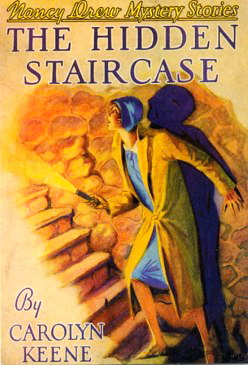
For anyone who has read the original editions of the early Nancy Drew mysteries, the lasting memory is of painful suspense.  Nancy Drew, alone at home at night, opens the door to a malevolent villain who threatens her with violence.  On a stormy eve, she breaks into her enemy’s sinister house; the cellar window bangs shut behind her, alerting the surly housekeeper who comes to investigate.  Locked in an upstairs bedroom, she finds the opening to the hidden underground passage, whose length she traverses with a flickering flashlight (that eventually fails), uncertain if she will encounter her nemesis in the rat-infested depths.  The ancient mansion in which she is staying has no phone and Nancy keeps her dangerous plans to herself, so there is a dread sense of isolation.

These scenes are from The Hidden Staircase, the second in the series.  There is a raw energy that is startling, beginning with the appearance of Nathan Gombet, tall and spindly like a “towering scarecrow”, with piercing eyes that repulse the young woman.  There is a Silence of the Lambs sinister quality to this character.  When Nancy happens into the room filled with his menacing taxidermied bird specimens (Hitchcock bestowed the same hobby on Norman Bates) along with live canaries in gilded cages, the sense of a deranged unpredictably violent character is complete.  There are the gothic atmospherics, from the architecture to the weather (always stormy, always night), and the queer happenings intended to frighten the elderly sisters into selling their family home – an infestation of flies, shadow figures on the walls, the disappearance of three black silk dresses.

il_fullxfull.290069581These touches came from the imagination of Mildred Wirt Benson, a woman from Iowa who was hired by the Stratemeyer Syndicate (creators of the Hardy Boys and the Bobbsey Twins, among many others) to ghostwrite the Nancy Drew mysteries under the pseudonym of Carolyn Keene:  she received $125 per volume in exchange for a vow of silence.  She wrote most of the volumes published from 1930 to 1953, but her role remained hidden until she testified in a court case between publishing houses in 1980.  Edward Stratemeyer created the series, but Benson gave life to the character who was to fire the imagination of generations of girls – the attractive blond amateur sleuth in her blue roadster, seeking justice for the downtrodden with her chums, Bess and George, and her endlessly patient beau, Ned Nickerson.  The early Nancy Drew is feisty, courageous, determined, outspoken, capable, and invincible, and it is worth seeking her out.  In 1959, she underwent a transformation as the original volumes were condensed and rewritten.  The revised version of The Hidden Staircase, which is the yellow-spined volume found in most book stores and libraries, is pallid, spiceless, and two-dimensional.  Gone is the colorful accomplice: “’You git, white man!’ she ordered, ‘or I’ll fill yo’ system full of lead.’”  Gone is the incompetent sheriff who inspires Nancy’s sarcastic disdain.  Gone is the frightening villain, replaced by a short stooped man who has no interest in taxidermy.  And because Nancy Drew is no longer alone at moments of danger, gone is the suspense.

The Hidden Staircase was Mildred Wirt Benson’s favorite.  Facsimile editions that reproduce the original 1930 volume are available, as are countless pre-1959 used copies.


The Polar Express

Image

The Polar Express by Chris Van Allsburg

1985

Illustrated by Chris Van Allsburg

At some point in every childhood, the first crack of doubt appears in the veneer of belief.  A child is confronted by a more jaded peer who asks witheringly, “Do you still believe in Santa Claus?”  The pressure is on.  The child faces a painful conundrum.  Should he or she really give up the carefully worded missives to the North Pole and the excitement of opening the replies (with their spidery rune-like writing and envelopes proclaiming “Sleigh Mail!”), the Christmas Eve plate of star-shaped sprinkle cookies and peeled carrots for Saint Nick and the reindeer, the laying awake in bed hoping to catch the sound of sleigh bells and the scattering of hooves on the roof, and the joy of rushing downstairs on Christmas morning to find the stockings filled – yes, Santa Claus really did come?  It’s a slippery slope, for where Santa goeth, the other two characters in the mythical trinity – the Easter bunny and the tooth fairy – are sure to follow close behind.

In The Polar Express, Chris Van Allsburg tells a story in which those who retain their belief are in an enviable state of grace.  On Christmas Eve, a boy arises from bed to find a train standing perfectly still in front of his sleeping house.  The cars are filled with children in their pajamas or nightgowns, all heading to the North Pole.  Upon arrival, Santa Claus chooses the boy to be the recipient of the first gift of Christmas, a silver bell from his sleigh.  On Christmas morning, the boy finds the bell under the tree and he and his sister hear the most beautiful sound in the world, while his parents hear nothing and think the bell is broken.  “At one time most of my friends could hear the bell, but as years passed, it fell silent for all of them.  Even Sarah found one Christmas that she could no longer hear its sweet sound.  Though I’ve grown old, the bell still rings for me as it does for all who truly believe.”polar express

Van Allsburg began as an artist rather than a writer, and his distinctive illustrations are imbued with a strong narrative current.  He borrows from the surrealists the juxtaposition of objects onto impossible backdrops – a house floating by the partially submerged heads of Mount Rushmore (in Ben’s Dream), a straight backed chair with nun levitating high above two priests in a cathedral (in The Mysteries of Harris Burdick), or the train in front of the house in The Polar Express.  The illustrations have a luminous mysterious quality, often with a vaguely ominous or unsettling undercurrent, as when the Polar Express passes silent wolves standing sentry in the forest.  This could not be further from the candy cane and gumdrop school of Christmas art.

 Image

Aside:  Fritz, a white bull terrier with a dark eye patch, first appears in The Garden of Abdul Gasazi, where he is turned into a duck by a fez-wearing magician.  Like Hitchcock in his own movies, Fritz turns up for a cameo role in each of Van Allsburg’s subsequent books.  In The Sweetest Fig,  his image appears on the label of a wine bottle.  In Probuditi, he becomes a tea pot.  In Two Bad Ants, he is a shade of himself in the spinning refuse of a garbage disposal.  In The Polar Express, he is a hand puppet impaled on the boy’s bedpost.

my photo of title page

In the Month of Kislev: A Story for Hanukkah

In the Month of Kislev: A Story for Hanukkah by Nina Jaffe

1992

Illustrated by Louise August

In a Polish shtetl, a hardworking but poor peddler has no money to provide even a single potato for his family during Hanukkah.  His three daughters, passing by the home of a wealthy merchant while returning from temple, stop outside his kitchen window and fill themselves with the aroma of latkes.  That night, they light the menorah, play the dreidel game, and contentedly crawl into bed, their hunger satisfied.  Each day they revisit the merchant’s kitchen window to smell the latkes, but on the eighth day they are apprehended.  The irate merchant hauls the peddler before the rabbi, demanding payment.  The rabbi asks the townspeople for their Hanukkah gelt and they drop their copper coins into his cloth bag.  Shaking the bag until all can hear the jingle of the coins, he tells the merchant that the sound of the gelt is just payment for the smell of the latkes.  Enjoined to return home and do good in the world, the chastised merchant mends his arrogant ways and every year thereafter invites the peddler and his family to join him for the Hanukkah celebration.

in the month of kislevNina Jaffe, an accomplished storyteller who has written a number of retellings of Jewish folk tales, has a penchant for riddle stories and justice tales.  In the Month of Kislev was based upon a story told to her by her father, who heard it in turn from a man who learned it from his Eastern European father.  It is a story that captures much of Jewish culture, not only the traditions of Hanukkah, but the intelligence and humor of rabbinical judgment and the injunction towards generosity and charity.

Louise August’s rich woodcuts incorporate a golden glowing warmth that matches the tone of Hanukkah, a holiday whose iconic candles celebrate light over darkness.  The historical realism of her illustrations provides a window into Jewish life in an Eastern European village at a time when such a life still existed.

christmas memory

A Christmas Memory and The Thanksgiving Visitor

A Christmas Memory by Truman Capote

1956

The Thanksgiving Visitor by Truman Capote

1967

Illustrated by Beth Peck

The creator of Holly Golightly, the worldly yet innocent gamine of Breakfast at Tiffany’s, immortalized another childlike character in two autobiographical holiday stories.  Truman Capote, born in New Orleans to a very young mother, was sent as a small boy to live in an eccentric household of elderly cousins in small town Alabama.  The youngest of these, a woman in her 60’s, became his closest friend.  Miss Sook was not quite of this world – she had never traveled more than five miles from home and had never read beyond the comics and the Bible – but she had the quiet dispassionate wisdom of the outsider.  Buddy, as she called the forsaken boy, was also someone who did not belong – he was a pretty boy who spent time reading and took up writing as a serious pursuit while in primer school.  In their separate loneliness, they each found a kindred spirit in the other.

christmas memoryA Christmas Memory begins on a crisp November morning: “Oh my……it’s fruitcake weather.”  Miss Sook, Buddy, and their feisty rat terrier, Queenie, set off with a dilapidated wicker baby carriage to collect windfall pecans.  They count the coins in their fruitcake fund, gathered over the course of a year and hidden under a loose floorboard, and purchase the necessaries, including a bottle of moonshine from the giant Indian, Mr. Haha Jones.  The curious recipient list for the fruitcakes includes President Roosevelt, a California couple whose car had once broken down in front of the house, Baptist missionaries in Borneo.  They hunt for the perfect Christmas tree in the woods, trim it with homemade paper cutout ornaments, and make kites for one another, as they do every year.  They each obtain an innocent delight from their holiday traditions, conducted in their own shared world, a world apart.

thanksgiving visitorThe Thanksgiving Visitor introduces a character who shatters that shared world – for an afternoon.  Over Buddy’s objections, Miss Sook invites Odd Henderson, the school bully and Buddy’s nemesis, for their Thanksgiving feast.  Having witnessed his enemy pocketing a cameo broach, Buddy takes his revenge by revealing the thief at the dinner table.  In what ensues, Miss Sook displays the wisdom of Solomon, Odd achieves a humble dignity, and Buddy is disgraced, having committed the one unpardonable sin of deliberate cruelty.

Truman Capote cultivated notoriety: he was known for his glamour-seeking pursuit of celebrity, his nasty penchant for scandalous gossip, his vituperative wit (most notoriously leveled at Gore Vidal with whom he had a much-publicized longstanding feud).  These two stories remind us of his more endearing (and enduring) qualities; clarity of prose style, pitch-perfect timing, and a poignant lyricism that is nowhere more apparent than in his memories of childhood.

Mrs. Goose’s Baby

Mrs. Goose’s Baby by Charlotte Voake

1989

Illustrated by Charlotte Voake

The book begins, “One day Mrs. Goose found an egg…”.  In retrospect, we understand the significance of that seemingly innocuous chicken, pecking in the background.  When hatched, the baby is fluffy and yellow rather than white and smooth, prefers pecking seeds to eating grass, refuses to swim in the pond when invited by the mother, and says “cheep” instead of “honk”.  Mrs Goose is the loving and protective mother.  “HONK!”, she says when welcoming her newly hatched baby, and two pink hearts float above her greeting.  In this fanciful story of maternal love, Mrs. Goose remains sweetly oblivious that her baby is a chicken.

What keeps this tale sweet but never cloying is the comedy of the illustrations.  There are the visual clues to the baby’s identity that are apparent to the reader but unnoticed by the goose.  There are the speech balloons, containing only the monosyllabic HONK! or Cheep!, borrowed from comics.  There is the humor of the baby’s transformation, given that chickens are intrinsically funny with their tiny heads, drumstick thighs, and pointy toes.  There is the final spread showing the mother goose and young chicken walking together through the forest, the former serene and oblivious, the latter highstrung and jittery, communicating in their two languages, “HONK”, “Cluck!”, while a girl, a boy, and a cat look on from the side of the path.mrs. goose's baby

Charlotte Voake creates airy pen and watercolor illustrations that convey humor and emotion with an economy of line.  Witness the expressiveness of the faces despite often having only dots for eyes.  She is delightfully adept at cats, dogs, chickens, and little girls, all of whom make frequent appearances in her work.  Ginger, her best-known book, features an orange tabby who is disgruntled by the appearance of a playful kitten who eats from his food bowl and invades the sanctity of his basket.  In Here Comes the Train, Voake depicts a family (her own) riding their bicycles to the footbridge that spans the tracks.  She gets it just right; the quiet waiting, the camaraderie, the gathering anticipation.  When the train whooshes underneath, we see the sparks flying from the locomotive’s wheels, hear the horn and the children’s screams, feel the rattle of the footbridge and the wind in the hair.  This must be the most visceral rendition of a train in children’s literature.  In addition to her own books, Voake has illustrated nursery rhymes (Over the Moon), classic fairy tales (The Three Little Pigs and Other Favorite Nursery Stories), Eleanor Farjeon’s Elsie Piddock Skips in Her Sleep, and the 16th century story, Gammer Gurton’s Needle – all of which are treats for those who love her whimsical visual style.

gorky rises

Gorky Rises

Gorky Rises by William Steig

1980

Illustrated by William Steig

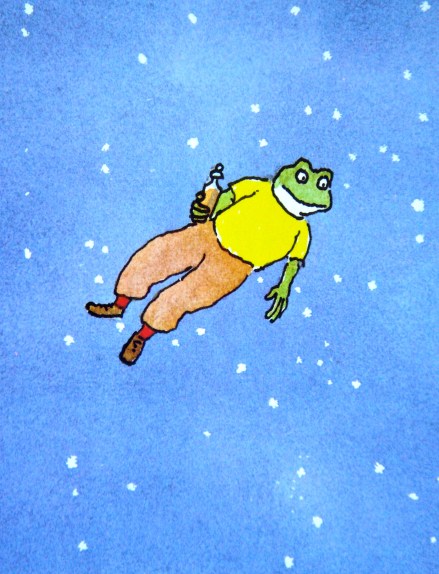
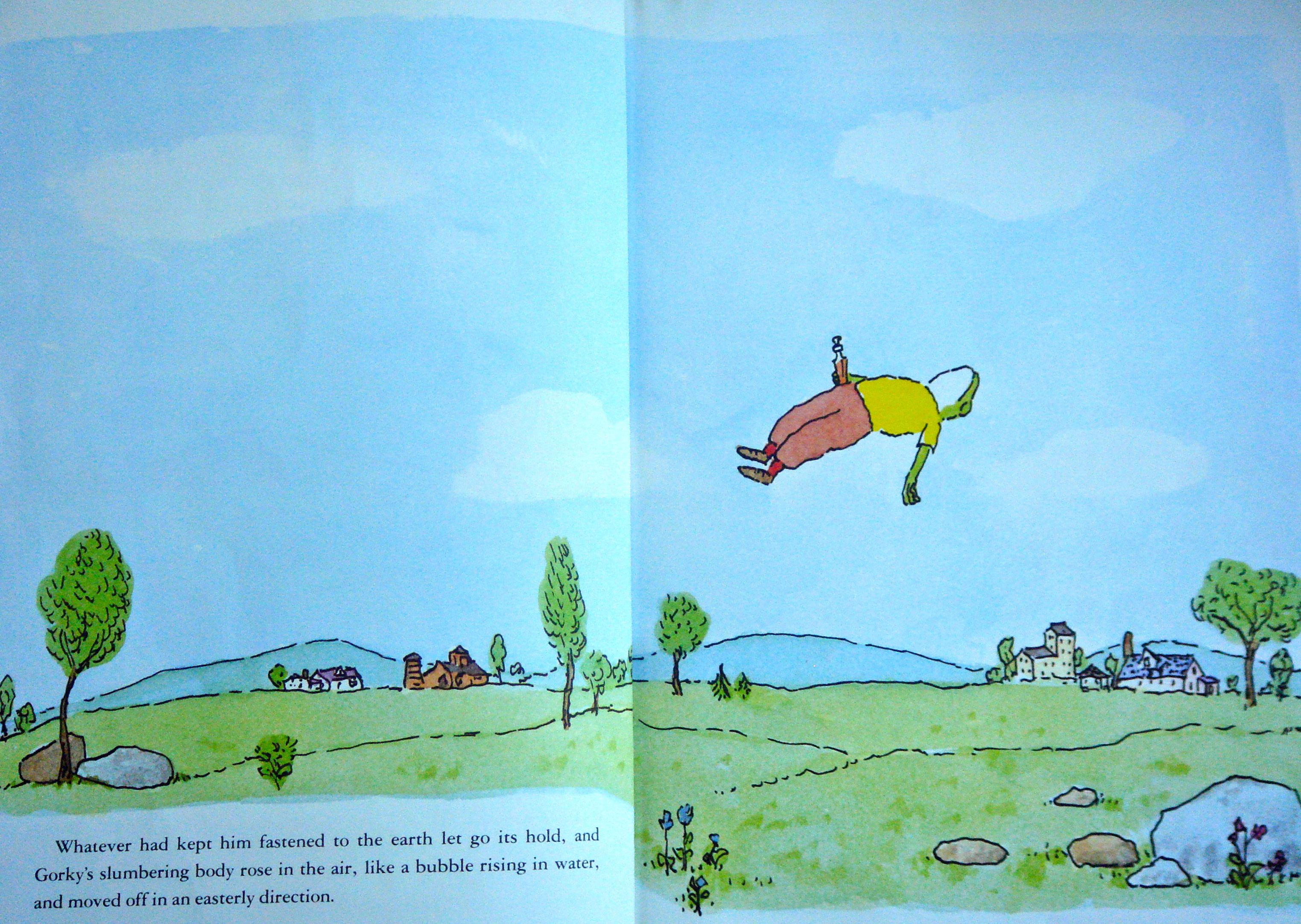
The story begins with Gorky, a green frog, concocting a magic potion at the kitchen sink.  After decanting it into a glass-stoppered bottle, he says an incantation (“Auga-looga, onga-ouga”), communes with nature, and falls asleep in a meadow.  “Whatever had kept him fastened to the earth let go its hold, and Gorky’s slumbering body rose in the air, like a bubble rising in water, and moved off in an easterly direction.”  Floating high above the earth, he encounters two fearsome kites, a hot air balloon, migrating geese, a lightning storm.  He performs aerial acrobatics for the earthbound creatures who gawk up at him in amazement.  “What the doodad was keeping him up there?” they wonder.  Night falls and he ponders the imponderables, realizes his loneliness.  As dawn breaks, he pours out his potion drop by drop and descends jerkily to earth.  His distraught parents are overjoyed to see him again.gorky rises

William Steig was intrigued by transformation and by journeys of self-discovery, and it should come as no surprise that Pinocchio was his favorite children’s book.  In Steig’s Caldecott Medal winning Sylvester and the Magic Pebble, a young donkey is transformed by a magic red pebble into a boulder.  He is locked in his isolation, through the changing of the seasons, until he is able to undo the charm.  The book ends, as most Steig books do, with a joyous reunion with family.  In Abel’s Island, a beautifully crafted chapter book, a newlywed mouse is separated from his beloved Amanda by a freak storm which deposits him upon an island.  He spends a year in solitude, devising methods of escape, battling his nemesis – the resident owl, and discovering his talent as a sculptor.

Steig grew up in a tenement neighborhood in the Bronx, son of Eastern European Jewish immigrants, in a household bubbling with creative intent.  His parents, a housepainter and a seamstress, were Socialists and their politics gave him a sympathy for the underdog that never faded.  His art and his children’s books portray his belief in the fundamental goodness of people along with a kind of pragmatic optimism.  His characters are free spirits who approach the world with an innocent sense of wonder and a delight in the strangeness of it all.  They marvel at the beauty of the universe, whether it be Gorky reveling in the scent of roses or Shrek infatuated with his stunningly ugly princess.

Steig was a patient and disciple of Wilhelm Reich, the radical Austrian psychoanalyst whose practice revolved around orgone, the universal energy source.  Viewed by some as a visionary and by others as a charlatan, Reich ultimately died in a penitentiary on a charge involving interstate commerce of his orgone energy accumulators.  Steig never lost his belief, and he spent a daily half hour in his orgone box for fifty some years.  If this contributed to the unique sophistication, beauty, and joy of his books, it was time well spent.