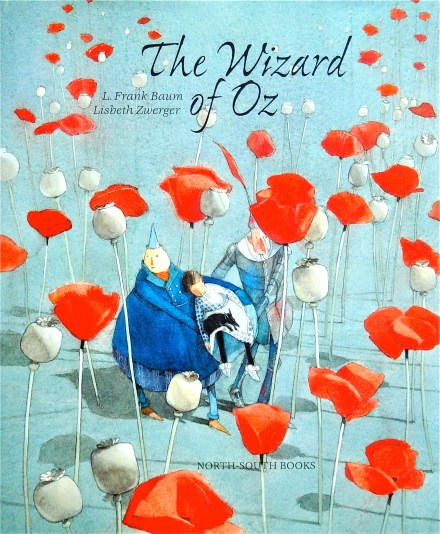
The Wizard of Oz

The Wizard of Oz by L. Frank Baum

1900

Illustrated by Lisbeth Zwerger

Of the many beloved children’s books, none has been more embraced by American popular culture than The Wizard of Oz.  Originally published in 1900, the book’s phenomenal success launched a slew of sequels, prompted Hollywood to create one of the most-viewed movies of all time, and inspired a number of wildly popular Broadway musicals.  The yellow brick road, the ruby slippers (silver in the book), the Wicked Witch of the West, Judy Garland singing the impossibly beautiful Over the Rainbow – these are all familiar and enduring icons in the American vernacular.  In reading the book today, it is startling how fresh and modern it feels.  There is nothing old-fashioned or nostalgic that would suggest that it was written over a century ago.

L. Frank Baum was an impresario of sorts who threw himself into a bewildering sequence of professions, most without great success.  He finally discovered his genius as a storyteller.  His imaginative universe was fresh and light – revolutionary qualities in a genre that was dominated by the dark, Germanic, and moralistic.  He combined Midwestern realism (Kansas tornado, talking scarecrow) with old-world fairy tale elements (evil witches, protective kisses), a phantasmagoria of bizarre hallucinogenic characters (blue Munchkins, Winged Monkeys, armless Hammer-Heads) with optimistic 20th century psychology to create a unique species of magic.

Dorothy and her three companions, the Scarecrow, the Tin Woodman, and the Lion, take center stage in their quests for home, intelligence, heart, and courage.  But Baum’s most original and complex creation was the Wizard.  Stripped of his disguises, he turns out to be a meek and humble charlatan who is the victim of the world’s desire to be fooled.  “How can I help being a humbug,” he said, “when all these people make me do things that everybody knows can’t be done?”  Witness the willingness of the three seekers to suspend their disbelief long enough to acquire their missing qualities.  It should be noted that Baum had become a Theosophist only a few years before writing his first Oz book, and he cannot have been unaware of the charges of fakery leveled against Madame Blavatsky when she caused teacups to materialize and tables to levitate.

Of the many illustrators of The Wizard of Oz, Lisbeth Zwerger best captured the character of the humbug.  She draws him as an awkward perplexed mad scientist with wings of wired hair framing his bald pate.  His vulnerability and his chagrin at having been exposed as a conjuror are apparent.  Zwerger also does justice to the bizarreness and surrreality of Baum’s imagination – perhaps Dorothy was not the only one to be overcome by the fragrance of the red poppies.  To complete the experience, a pair of emerald-green tinted glasses, the cardboard decorated with occult sorcerer symbols, is secreted in the back of Zwerger’s editions, to be slipped on when Dorothy and her friends arrive at the Emerald City.

The Story of Ferdinand

The Story of Ferdinand by Munro Leaf

1936

Illustrated by Robert Lawson

As a young bull, Ferdinand prefers lying quietly under a cork tree and smelling the flowers than cavorting and butting heads with his peers.  When five men from Madrid come to select the fiercest bull for the bullfight, Ferdinand is alone in having no aspiration to be picked.  Unfortunately, he sits on a bee, his ensuing response to the sting is construed as just the fierceness and anger that are sought, and he is carted off to the city.  There, the procession of apprehensive bandilleros, picadors, and matador is followed into the bullring by a meek Ferdinand, who sits down in the center, captivated by the fragrance of the flowers in the ladies’ hats.  Robbed of the opportunity to show off their skill and daring, the men are irate.  Ferdinand is returned to his favorite cork tree, in whose shade he can continue to sniff the flowers.

Few children’s books have sparked as much controversy as this seemingly innocuous tale of a bull.  Published at the onset of the Spanish Civil War, the book was banned in Spain.  In Nazi Germany, Hitler ordered it to be burned, while in communist Russia, Stalin granted it privileged status.  In the United States, it was denounced variously as pro-fascist and pro-communist, as a paeon to pacifism and a parody of same.  Ghandi is said to have considered it his favorite book.  Munro Leaf denied that he had intended the story to have any political message and simply wrote it to amuse children.  Children, ignorant of the response of the world leaders, have enjoyed the book for over 60 years (and in 60 languages) and never fail to be delighted by Ferdinand’s response to the bee sting.

Leaf wrote the book on a yellow legal pad in a single sitting so that his friend, Robert Lawson, would have something to illustrate.  It is difficult to imagine the text in isolation from Lawson’s strong black and white line drawings.  They are startling in their boldness, the power of their caricatures of human natures, and the sophistication of their depiction of Spain.  The whimsical touches (for example, the strings of corks hanging from the cork tree) stand in contrast to the oppressive vultures or the rogues gallery of the men from Madrid with their ominous air of evil.  Leaf may not have had anything in mind other than an engaging children’s story, but Lawson’s illustrations add an unsettling sociopolitical commentary.  It is the combination of the text and illustration, the collaboration of Leaf and Lawson, that makes for the rich experience that The Story of Ferdinand provides.  Lawson’s talent as a distinctive illustrator of children’s books was honored when he received a Caldecott Award, not for The Story of Ferdinand, but for a largely forgotten book he wrote himself, They Were Strong and Good.

Aside: The Disney film, Ferdinand the Bull, won the 1938 Academy Award for Best Animated Short.  The matador was a caricature of Walt Disney, while the other men in the bullring were caricatures of Disney artists.

treasure island

Treasure Island

Treasure Island by Robert Louis Stevenson

1883

treasure island“Fifteen men on the dead man’s chest –

Yo-ho-ho and a bottle of rum!

Drink and the devil had done for the rest –

Yo-ho-ho and a bottle of rum!”

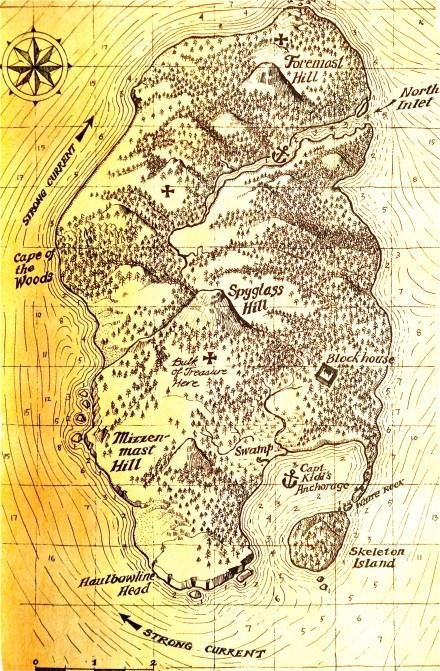
Inspired by a fanciful map drawn to amuse his step-son, Robert Louis Stevenson wrote Treasure Island, his first novel and his first work for children.  With its taut story-line and crisp prose, Treasure Island is a most suspenseful adventure tale.  Stevenson was adept at driving a plot, and what better components than a buried treasure and a mutinous crew of pirates outnumbering the virtuous by three to one?

More importantly, Stevenson was a master at creating character, and Treasure Island is really a book about Jim Hawkins and Long John Silver.  Jim, the narrator, is the young lad who finds the treasure map in the effects of the fierce buccaneer, Billy Bones, thus setting off the train of events.  He it is, through a series of rash decisions, who overhears the pirates’ mutinous plans, encounters the marooned Ben Gunn, and secrets the ship for later escape – all necessary to the salvation of his friends.  Long John Silver, alternately Jim’s nemesis and protector, is one of the most psychologically nuanced characters in fiction.  Ever mercurial, impressively astute, the one-legged pirate is charming and obsequious one moment and heartlessly cruel and treacherous the next.  (Fascinated by duality, Stevenson wrote The Strange Case of Dr. Jekyll and Mr. Hyde three years later.)  Even when at his most despicable, it is impossible not to admire his intuitive grasp of human nature and the ease with which he manipulates others to his advantage.  Against our reasoned judgment, we find him likeable and are relieved when Stevenson allows him to jump ship in a Spanish American port, together with a bag of gold and Cap’n Flint, his parrot, (squawking “Pieces of eight! Pieces of eight!”), thus saving his neck from the gallows.

Stevenson excelled at writing vivid description – witness his handling of the coracle, Ben Gunn’s goatskin teacup of a boat, dancing through the waves.  He also had a keen ear for dialogue.  Treasure Island is enhanced by a reader who can do justice to the dialects of the various voices, and this is even more true of Kidnapped, his other great adventure novel, in which the Scottish brogue is as key to the created atmosphere as the rich description of the highlands.

I Am A Bunny

thumbnailI Am a Bunny by Ole Risom

1963

Illustrated by Richard Scarry

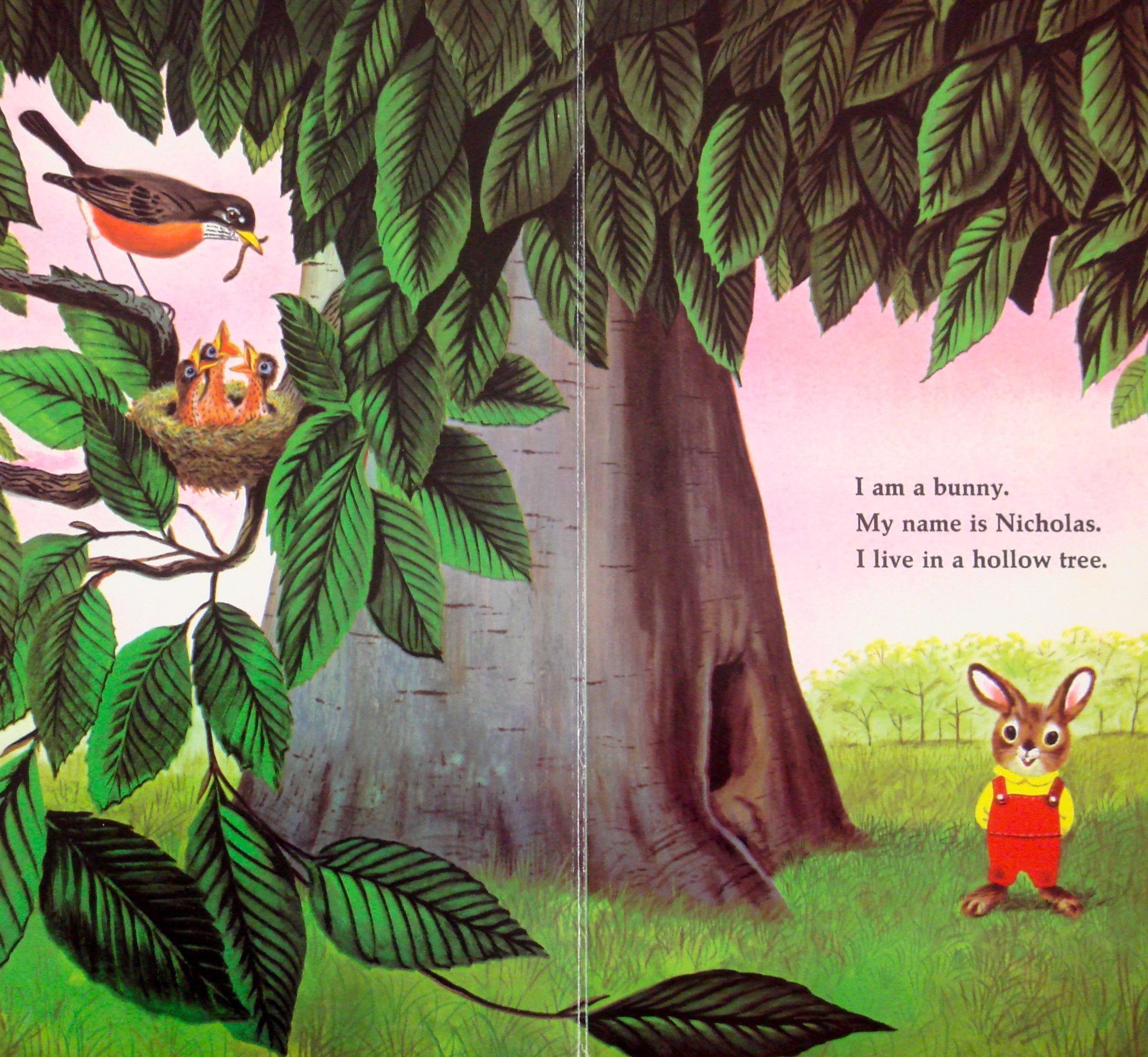
The story is minimal.  A bunny faces the reader and introduces himself.  “I am a bunny.  My name is Nicholas.  I live in a hollow tree.”  Disarmingly straightforward, he tells what he likes to do during each of the four seasons: pick flowers and chase butterflies in the spring, look at frogs and blow dandelion seeds in the summer, watch the leaves falling in the autumn and the snow falling in the winter.  At the end, he curls up in his hollow tree and falls asleep.DSC00153-2

As with many of the Golden Books, the strength of I Am a Bunny lies in its rich illustrations.  Ole Risom, the Danish art director for Golden Press during the 1950’s and 1960’s, invited his good friend, Richard Scarry, to collaborate on this book.  There were several other books in this series, also written by Risom (I Am a Mouse, I Am a Puppy, I Am a Kitten), but the first stands apart.

Richard Scarry was a prolific writer and illustrator, but this is arguably his most beautiful book.  Nicholas (named for Ole Risom’s son) is a bright-eyed rabbit, dressed in a soft yellow shirt and red white-stitched overalls.  On each page, through an interesting use of perspective, Nicholas is dwarfed by some element of nature which strikes us with its giant-sized detail in the foreground.  Whether a robin feeding a worm to its young, a flowering dogwood, a swallowtail butterfly, or a trillium in bloom, each is presented with painstaking accuracy.  In one picture, Nicholas cavorts with a swarm of colorful butterflies that cover the page (there are twenty four, each a different species) and in another, he is camouflaged by a swirl of autumn leaves, some larger than he.  To illustrate, “In the summer, I like to lie in the sun and watch the birds.”, Nicholas lies on a grassy hill under cumulus clouds, ripe wild strawberries within reach, watching an eastern bluebird, common redpoll, Eurasian tree sparrow, and yellow-throated vireo. This is the perfect evocation of a lazy summer day in childhood, and one that would inspire anyone to go outside and lie down in the grass for awhile.DSC00152-2

family sabbatical cover

Family Sabbatical

Family Sabbatical by Carol Ryrie Brink

1956

Illustrated by Susan Foster

Every book is a product of its times and Family Sabbatical is quintessentially 1950’s.  “”If I Russia, the Turkey might fall off the China into the Greece, causing loud Wales.  Abyssinia.’”  This is from George, the 10 year old middle child, who attempts to teach American colloquialisms (super duper, boy-o-boy) to Mademoiselle Beauregard, the dearly befuddled elderly governess.  The family is Midwestern, the children kind-hearted, and the humor literate and corny – a slice of ‘50’s Americana.


family sabbatical pg. 9

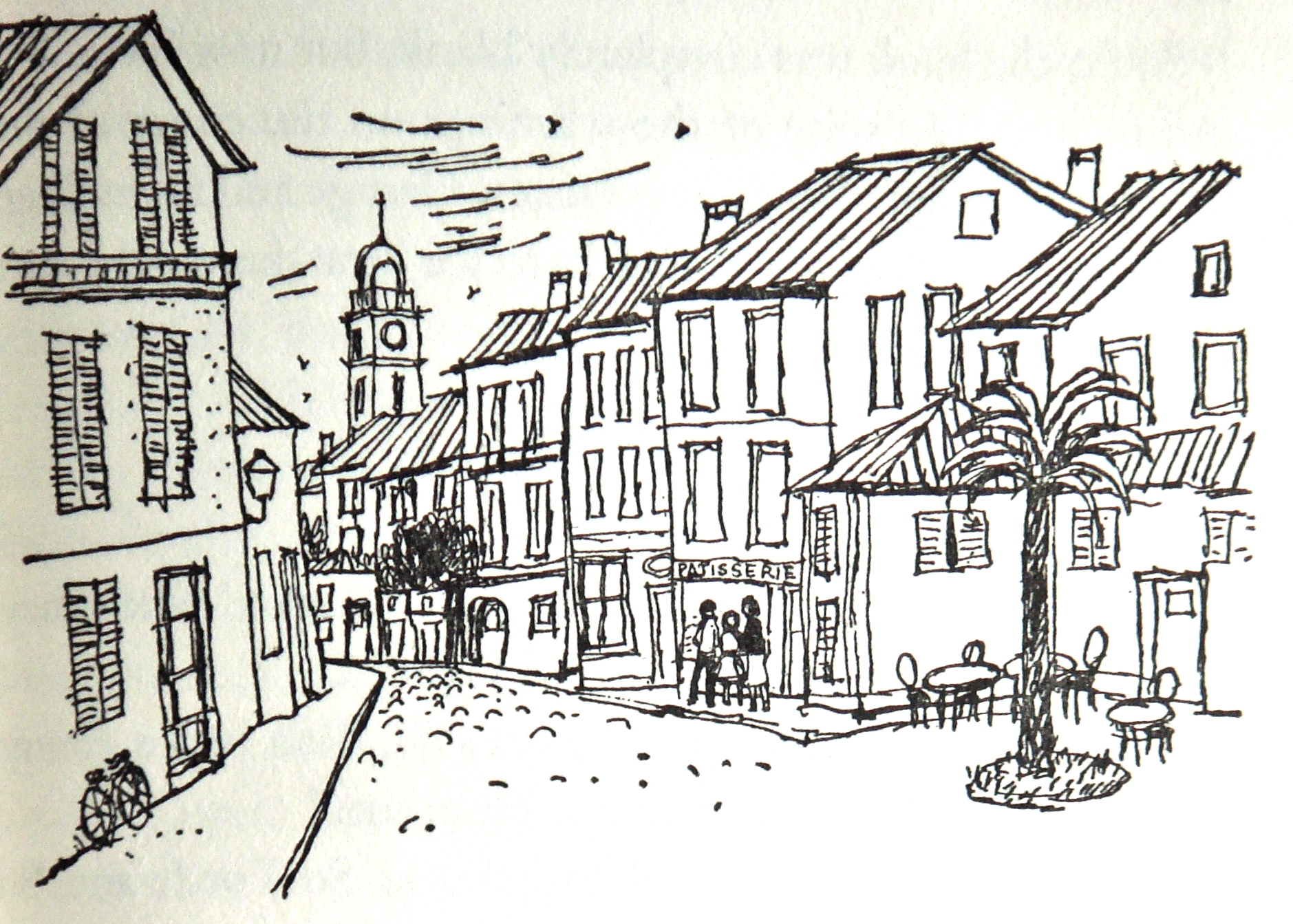
Yet it all takes place in France, initially in Cannes, later in Paris.  The Ridgeway’s are on sabbatical – the professor father is conducting historical research, the writer mother is working on a mystery, the three children are learning French.  Thirteen year old Susan is the capable/competent eldest, George is the naturalist and rock collector, and 7 year old Dumpling is the linchpin, precociously grounded with the wisdom of youth.  They live in the Grand Hotel Majestic et de l’Univers (known as the Grand Hotel and So Forth and So Forth), an edifice whose imposing name is insufficient to disguise aging decrepitude, eccentric bathrooms, and an erratically functioning gilt elevator.

But the second time they wanted to go up in the ascenseur, they saw that attached to the bird-cage door was a neat printed card which said: L’ASCENSEUR NE MARCHE PAS.

“But to marche means to walk,” said Susan, who was already learning some French.

“It means,” said Father, “that the elevator is not walking today.”

“But it means that we are,” said Mother.

Enter Mademoiselle Beauregard, the excitable spinster engaged to teach the children, a vehicle for the rich genre of humor that involves the French accent (think of what Peter Sellers as Inspector Clouseau was able to do with the words “room” and “phone”).  “Shorsh” delights in leading her astray – his greatest coup is inducing her to substitute “shut up” for “will you very kindly make a leetle more silence if you please”, an expression she innocently uses on the Father, to his horror.  Enter also Her Royal Highness, the Princess Adelaide Louisa von Mettnock-Hohenwurtzel (umlaut over the u), a fellow resident at the hotel, who turns out to be a kindly old woman rather than the golden-haired invalid that the children imagine.  Enter Mme. Ernestine DuChamel, quickly nicknamed the Earnest Camel, the proprietress of the Parisian private school in which the children are enrolled.  By the end of the first morning, Susan and George, with their rudimentary French, have been demoted to the first grade where they sit in tiny chairs alongside Dumpling.   Set off by these memorable characters, the American children experience the simple adventures of childhood, all tinted by the exoticism of French culture.

lotties new beach towel

Lottie’s New Beach Towel

Lotties’s New Beach Towel by Petra Mathers

1998

Illustrated by Petra Mathers

Chickens tend to be cast as dithering ditzes, along the lines of Henny Penny and “the sky is falling.”  It is a sign of Petra Mather’s imaginative originality that her modest heroine, Lottie, is a hen.

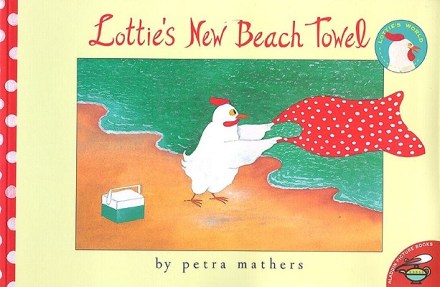
Lottie is squeezing lemons and making peanut butter and banana sandwiches when the mailman leaves a package from her Aunt Mattie.  She opens it to find a beach towel, red with white polka dots.  Picnic lunch and towel in hand, Lottie heads for the beach to meet Herbie for an outing in his boat.  The story is a simple day in the life, with the myriad uses of the towel (as an island refuge for sand scorched feet, as a sail for a dead engine, as a wedding veil for a bereft bride, as a shawl when night descends) as the binding thread.

With minimal text, a simple plot line, and colorful clean pictures, Petra Mathers creates two memorable characters who enjoy a gentle loving friendship.  Lottie, grounded and competent, leads a rich and creative life – she makes lemonade from lemons, knits socks for Herbie’s webbed feet (he is a duck), strikes up new friendships with the wedding party, composes a letter on her old fashioned typewriter.  Herbie, sporting a hat emblazoned “Capitano”, is a dear old salt who repeats silly jokes and relishes a good cake (or anything else that can be eaten).  Lottie is affectionate and gently mocking.  Herbie acknowledges his foibles sheepishly, sustained by her understanding.  They are both decent and tender hearted.

They are also comical.  Even when read a hundred times, children always laugh when Lottie mistakes a starfish for her foot (“Silly me.”)  They laugh when the motor dies (“I think it’s just tired,” said Herbie.  “I think it just went to sleep,” said Lottie.)  They laugh when Herbie is messily gluttonous (“I’m so hungry I don’t care if there is sand on my sandwich.  Get it, Lottie?”  “Yes, Herbie, and jelly on your belly.”)  The bright fresh watercolor illustrations add humor, beginning with Lottie whose red crest variously resembles a floppy water balloon, a beret, a windsock, or an exclamation point.

Petra Mathers has written and illustrated a number of other distinctive books, beginning with Maria Theresa, the story of a hen who flies the coop and joins a circus.  Theodor and Mr. Baldini, one of her most original stories, features a dog who begins to speak.  His first words – “Beef Bits again?”

wolves of willoughby chase

The Wolves of Willoughby Chase

The Wolves of Willoughby Chase by Joan Aiken

1962

Illustrated by Pat Marriott

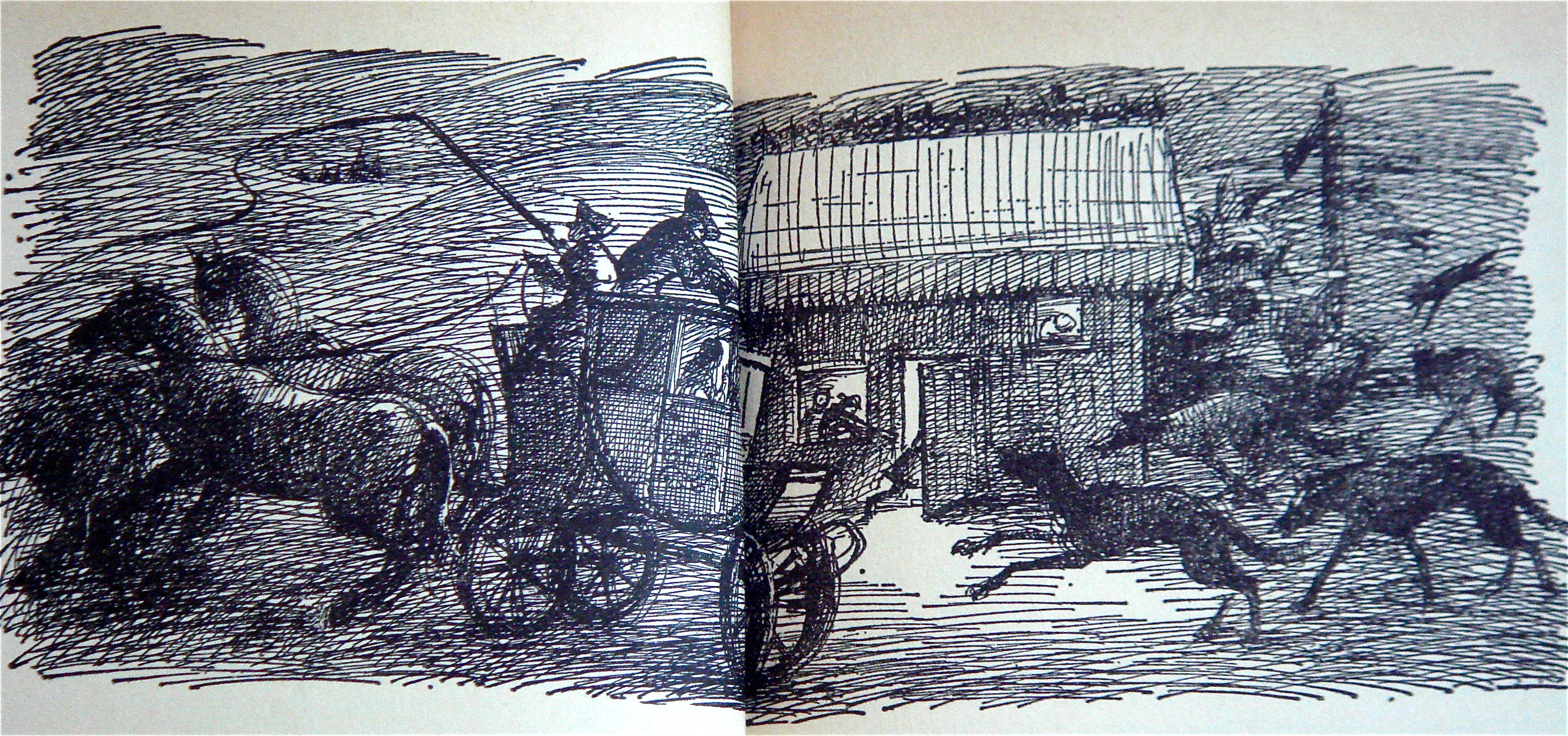
The fair-haired orphaned Sylvia leaves her aged Aunt Jane to live with her cousin Bonnie at the country estate known as Willoughby Chase.  On the overnight train journey, Sylvia is joined in her compartment by Josiah Grimshaw, a strange man who attempts to befriend her with chocolates and tea cakes.  When they are awakened by a lurching stop, Sylvia looks out on the frozen landscape to see wolves streaming across the snow.  They begin throwing themselves against the train window until the clasp gives, the glass shatters, and a wolf bounds into the compartment.  Mr. Grimshaw dispatches it with a shard of broken glass and then heaves its carcass out the window.

This singular scene, with a tone unlike that of any other book in children’s literature, gives a taste of Joan Aiken’s disorienting imagination.  The book is set in 19th century Britain but the improbable appearance of the sinister wolves reveals the backdrop to be pseudohistorical.  Aiken places her stories in the past, but she has taken liberties with history.  In a later book, we learn that the wolves have invaded England from the continent through a tunnel under the English Channel.  Aiken’s world is just a hair off-kilter, which makes it much more unsettling than a world of overt magic.

wolves of willoughby chaseWhen Sylvia reaches Willoughby Chase, she and Bonnie discover that Mr. Grimshaw is in league with the wicked Letitia Slighcarp, a distant relative in whose care the girls and the estate have been left during the absence of Sir Willoughby and Lady Green.  After sacking all the loyal retainers, Miss Slighcarp packs her charges off to an orphan work house in the bleak industrial town of Blastburn.  They make their escape from the cruel Mrs. Brisket with the aid of Simon, the forest boy who lives in an underground cave on the estate with his geese.  There is a wonderful scene in which the feverish Sylvia is tucked into a donkey cart with feather-filled mattress and quilts below and warm feathery geese on top.  Lulled by the soft warmth, she immediately falls asleep.

Joan Aiken came from a literary household – her father was the Pulitzer Prize winning Conrad Aiken and her stepfather was Martin Armstrong.  Home-schooled until the age of 12, she read voluminously as a child.  The influence of Charles Dickens is obvious in her work (note the names of the evil characters), as is that of Victor Hugo.  The wolves are borrowed from The Box of Delights, an unusual book by John Masefield that is little known in the U.S.  The starkly opposing forces of good and evil, with the inevitable triumph of the former, provide the makings of a gothic morality play or a wild melodrama (there are shades of both).  Aiken leavens the battle with a deadpan humor, sometimes with a morbid touch in the style of Edward Gorey (who provided the jacket illustrations for some editions).  For those intrigued by Aiken’s distinctive tone and strange imagination, there are a dozen books in the Wolves series alone.

Max’s Chocolate Chicken

Max’s Chocolate Chicken by Rosemary Wells

1989

Illustrated by Rosemary Wells

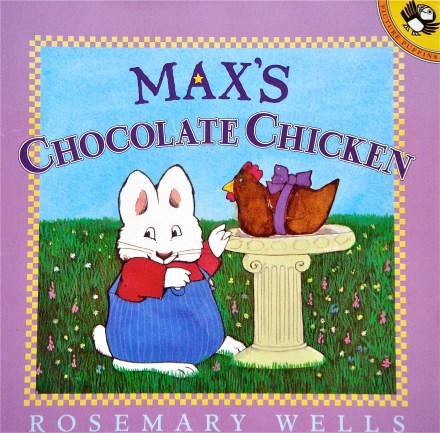
The book begins with an Easter bunny, in yellow paisley tails and purple vest, backed by a star studded sky, gliding low and gently dropping Easter eggs from his basket onto a grassy meadow.  He places a chocolate chicken, wrapped round with a pink ribbon, in an empty birdbath.  Max stares at the chicken with a look of weak-kneed rapture and proclaims his love.  Enter Ruby, his older sister, who interrupts his lovestruck revery to lay down the rules.  The Easter egg hunt is to be a competition.  Winner takes the chicken.  She admires each colorful egg she finds.  Max delights in floating his basket in a mud puddle, collecting acorns, following a trail of ants.  While Ruby, Midas-style, counts her eggs, Max slips away.  When he emerges from his hiding place, mouth covered with telltale chocolate, Ruby remonstrates.  “’Max……how could you do this to me?’”  Behind her back, we see the Easter Bunny’s hand slipping a chocolate duck onto the birdbath.  The book ends with Max’s protestation of love to a new object of desire (and we see that he has already broken off the tail).

max's chocolate chickenMax’s Chocolate Chicken is one in a series of over two dozen Max and Ruby books.  Ruby, usually well-intentioned, sometimes self-serving, tries to impose her agenda on her younger brother.  Indifferent to her priorities, Max always succeeds in following his own very different agenda, quietly making an end-run around his sister’s plans.  There is neither animosity nor rancor in their relationship.  There is much humor, however, as we watch Ruby persist, over and over, in her wrongheaded belief that she can prevail.

Rosemary Wells is a brilliant humorist, the best there is in the picture book world.  She learned what she needed to know about comedy and timing from Sid Caesar and Jackie Gleason.  Her touch is deft and fresh, subtle and intelligent.  Her amazing gift is the ability to appeal equally to children and adults – and the humor never stales, despite endless readings.  Who else can claim as much?  The storylines ring true (the siblings were based on the author’s daughters, Beezoo and Virginia), the writing is succinct and clever, and the illustrations create humor through minute shifts of mouth or eye that perfectly express characters’ feelings.

Max and Ruby are bunnies, but that is incidental.  With the notable exception of the white West Highland terrier who stars in the McDuff series, the world according to Rosemary Wells is filled with skunks, guinea pigs, raccoons, kitties, dogs, and ducks, all wearing clothes and behaving like people.

Aside:  “Drink your milk, Fritz,” said Fritz’s father.

           Fritz put a dab of relish in his milk

           so that it would turn a weird color.

           “Something’s wrong with it,” said Fritz.

                               (From Fritz and the Mess Fairy)

danny the champion of the world

Danny the Champion of the World

Danny the Champion of the World by Roald Dahl

Illustrated by Quentin Blake

1975

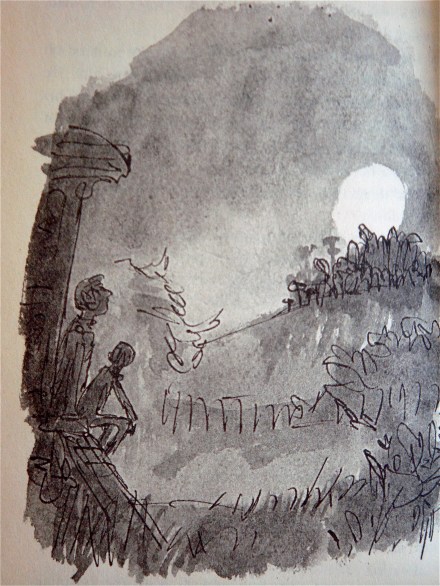
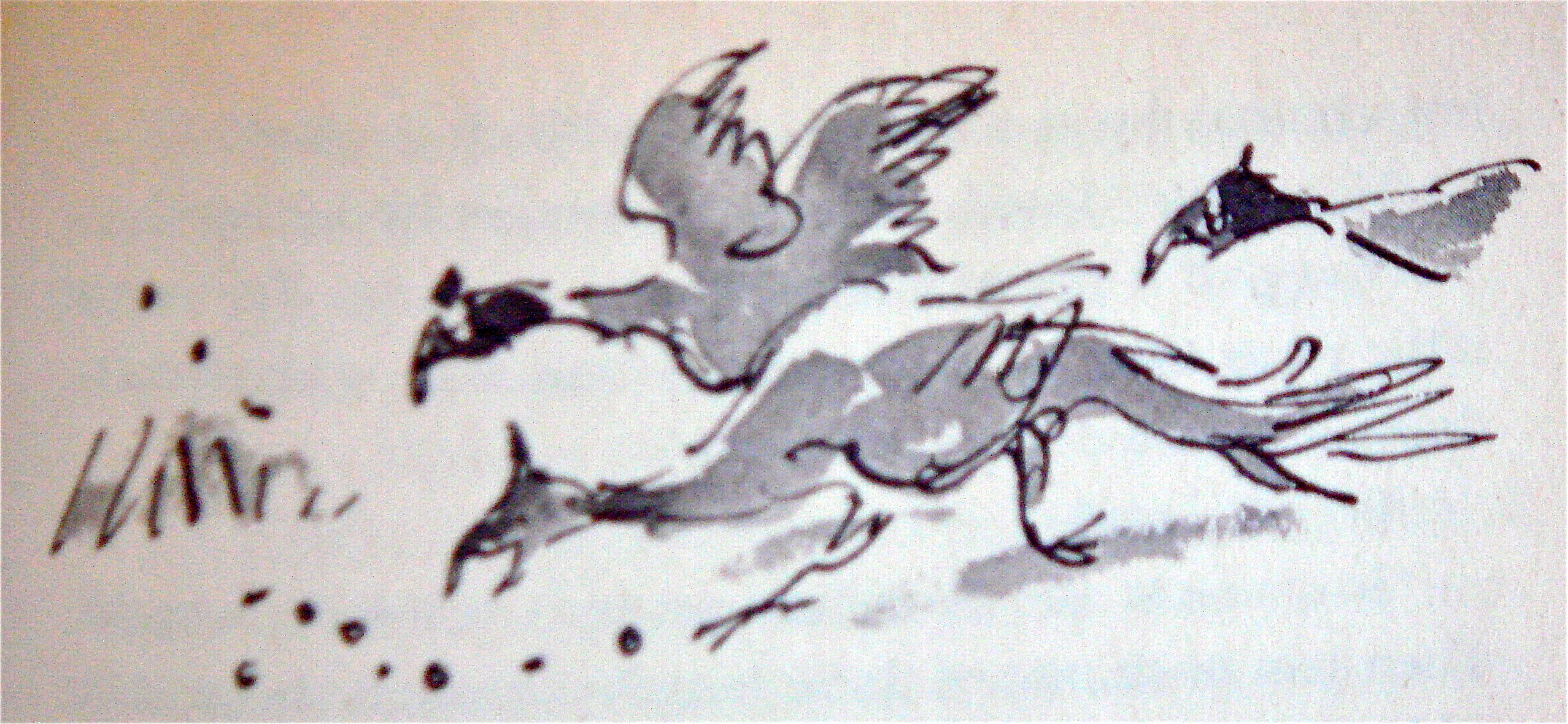
Danny lives with his father in an old painted gypsy caravan with built-in bunk beds, a wood-burning stove, and an apple tree out back.  His father, a car mechanic with an old-fashioned country filling station, is the perfect boyhood companion and the two have an idyllic life together tinkering on car engines, making kites, and launching tissue paper fire balloons on windless nights.  At the age of 9, Danny discovers that his father has a secret life – as a pheasant poacher in Mr. Victor Hazell’s woods, Mr Hazell being the arrogant and vulgar brewery owner and property baron of all the lands surrounding the filling station.  (“As he flashed by we would sometimes catch a glimpse of the great, glistening beery face above the wheel, pink as a ham, all soft and inflamed from drinking too much beer.”)  His father initiates Danny into the art of poaching by revealing his two pheasant-immobilizing methods, The Horsehair Stopper and The Sticky danny the champion of the worldHat, both based on the pheasants’ inordinate love of raisins.  Danny invents a new method, involving raisins laced with sleeping pill powder, and he and his father try it out the night before Mr. Hazell’s annual hunting party, thus thwarting his vain attempts to be accepted by the titled upper class.  Along the way, they receive help of various kinds from the kind Doc Spencer, the upright constable, the vicar’s wife, and the local taxi driver, all of whom turn out to be unlikely members of the poaching underworld.

danny the champion of the worldOf all Roald Dahl’s books, Danny the Champion of the World is the gentlest.  It is suffused with the tender love that exists between Danny and his father, two figures drawn close since the death of Danny’s mother when he was four months old.  The book is unusual for being naturalistic – there are no witches, no giant peaches, no magical dream powders.  There are scenes that are as funny as any that exist in Dahl’s writing (witness the rising of the pheasants from the baby carriage as the effects of the sleeping pills wane), but he does not resort to the nonsense verse, silly naming, and general absurdities that are his usual stock in trade.

Roald Dahl was particularly fond of this story.  He originally wrote it as an adult short story that appeared first in the New Yorker in 1959 and subsequently in the collection, Kiss Kiss.  Although he made significant changes when he revised it for children, including the switch from two friends to a father and son, the basic plot line remained intact and whole passages were lifted verbatim from the story.  Dahl often reworked an idea – the genesis for The BFG came from a bedtime story told by Danny’s father about The Big Friendly Giant.

little bear

Little Bear

Little Bear by Else Holmelund Minarik

Illustrated by Maurice Sendak

1957

In 1957, two authors, independently, set out to write a book that could help young children learn to read.  Else Holmelund Minarik, a first grade teacher on Long Island, was prompted by the dearth of interesting books for early readers, her young daughter among them.  Dr. Seuss was given a list of 348 words by his publisher and challenged to do something with them.  The results were Little Bear and The Cat in the Hat, each written with a vocabulary of fewer than 250 mostly monosyllabic words.  It is remarkable that such a limited palette could be transformed into two such divergent reading experiences.  Dr. Seuss concocted a frenetic rhyming wonder about the Cat in the Hat and his kite-flying sidekicks, Thing 1 and Thing 2, who create havoc while the mother is away.  Else Minarik invented Little Bear, a lovable creature who enjoys the pleasures that come from the imagination, friendship (with Hen, Duck, and Cat), and a loving mother.  Both books have retained their popularity for more than half a century and children should be forever grateful that their publication spared future generations the robot-like tedium of the Dick and Jane primers in which nothing ever happened (“See Spot.  See Spot run.”)

Minarik’s gift was the creation of character with an economy of words, especially memorable in the figure of Mother Bear who is wryly humorous, playful, and reassuring.  When Little Bear makes himself a space helmet and declares his plan to fly to the moon like a bird, she responds with tolerant skepticism.

little bear

“And maybe,” said Mother Bear, “you are a little fat bear cub with no wings and  no feathers.

“Maybe if you jump up you will come down very fast, with a big plop.”

“Maybe,” said Little Bear.  “But I’m going now.  Just look for me up in the sky.”

“Be back for lunch,” said Mother.

When Little Bear wanders back, pretending in his mind that he is having a lunar experience, his mother greets him, “But who is this?  Are you a bear from Earth?”  And they enjoy the shared pretense until Little Bear decides it is time to resume his true persona so he can envelop himself in the arms of his real mother.

little bear's friendElse Minarik’s writing was paired with Maurice Sendak’s illustrations for Little Bear.  Both were immigrants, of sorts.  She came from Denmark at the age of four and imbued her books with her memories of an idyllic childhood in the old country.  He, the son of Polish immigrants, had a miserable growing-up in Brooklyn, steeped in tragic stories of shtetl persecution.  Sendak may have given vent to his personal demons in Where the Wild Things Are and In the Night Kitchen, but for Little Bear he got the tone just right for Minarik’s childhood eden.  The costumes are late 19th century with pinafores, bonnets, sweeping dresses, capes, and top hats – for everyone but Little Bear himself, who wears his own fur coat.  For the space helmet, Sendak devised an upended cardboard box with ear flaps and sprung coil antennae.  Sendak illustrated the first five in the Little Bear series (Little Bear, Father Bear Comes Home, Little Bear’s Friend, Little Bear’s Visit, and A Kiss for Little Bear) and it is best to stick with these.  Note in the last of them, Little Bear paints a picture of a Wild Thing as a gift for his grandmother.