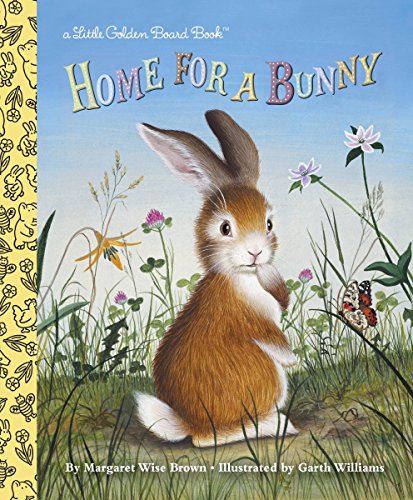
Home For a Bunny by Margaret Wise Brown
1956
Illustrated by Garth Williams
“In the Spring a bunny came down the road.
He was going to find a home of his own.
A home for a bunny,
A home of his own,
Under a rock,
Under a stone,
Under a log,
Or under the ground.
Where would a bunny find a home?”

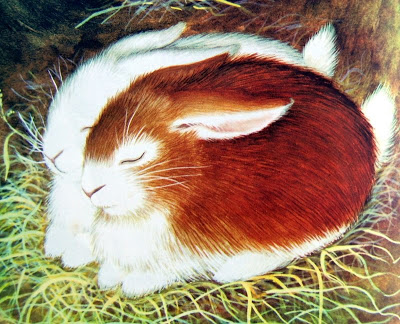
Home For a Bunny chronicles the search for home. A bunny passes a robin’s nest, a frog’s bog, and a groundhog’s log, before meeting another bunny and finding his rightful place in a cozy burrow. Garth Williams, the illustrator of Little Fur Family, Stuart Little, and Little House in the Big Woods, among others, provided the naturalistic illustrations – in his hands, the natural world awakening to springtime becomes the essential backdrop to the story.
Home For a Bunny was one of fifteen stories by Margaret Wise Brown that were published as Little Golden Books. Launched in 1942, the Little Golden Books revolutionized the publishing world by creating a populist mass market for children’s books. Instantly recognizable with their gold binding and distinctive end plates, they were displayed prominently in metal racks and sold in grocery stores, five and dimes, and drug stores. They cost 25 cents. They continued to cost 25 cents for the next twenty years. Among the initial set of twelve books was The Poky Little Puppy which became the best-selling picture book of all time. Janette Sebring Lowry, the author, received a flat fee of $75.

This Little Golden Book belongs to …
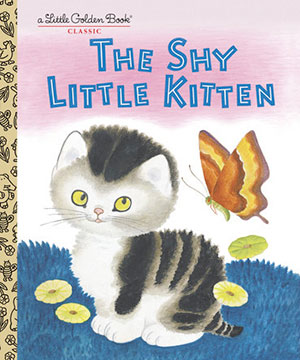
Before 1942, a popular children’s picture book might sell 10,000 copies. During the heyday of the 1940’s and 1950’s, one third of Golden Book titles sold a million copies or more. Part of this was because of affordable cost and accessibility and part because of a pool of extraordinary artists who created iconic illustrations that are instantly recognizable. Take The Shy Little Kitten, The Tawny Scrawny Lion, or The Saggy Baggy Elephant (Gustaf Tenggren), I Can Fly (Mary Blair), The Three Bears (Feodor Rojankovsky), Scuffy the Tugboat (Tibor Gergely), Little Boy With a Big Horn (Aurelius Battaglia), Chicken Little (Richard Scarry, who began his career as a Golden Books contract artist) – the art was eye-catching, highly original, surprisingly sophisticated, and nostalgia-inducing. The texts, in general, played second fiddle to the art. An exception to this was the writing of Margaret Wise Brown, whose poetic words were displayed in equal partnership with the illustrations. Among the most striking were The Color Kittens (Alice and Martin Provensen), The Whispering Rabbit (Garth Williams), and The Train to Timbuctoo (Art Seiden).


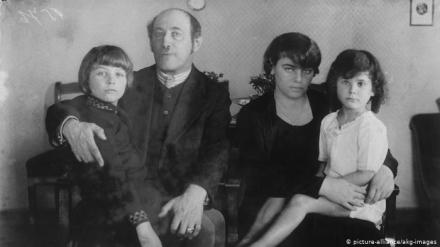


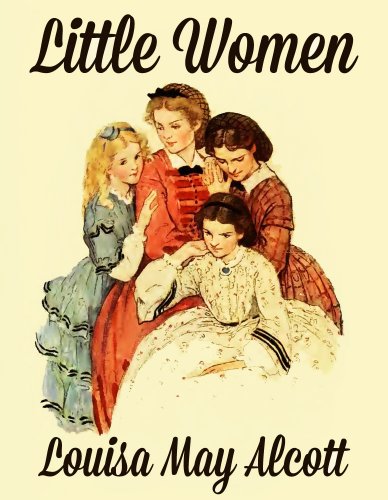

 Louisa was not without her share of sentimentality. One of her three sisters died at the age of 22. She had Beth, the fictional sister, follow suit. Beth, the impossibly kind, shy, selfless girl who Jo loves deeply. Her death would wring tears from a stone.

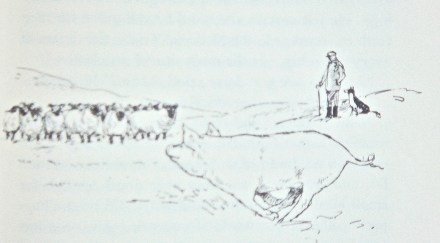
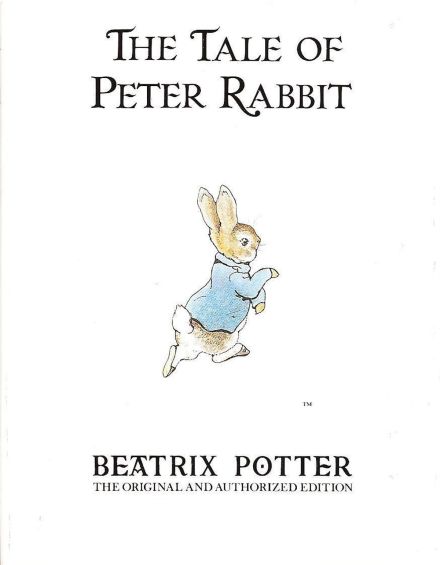


 later people her stories. As a young adult, she developed a passionate interest in mycology and her botanical illustrations of fungi and lichens were highly regarded by other naturalists. In her children’s books, her illustrations of animal characters have become iconic, but her tree trunks, leaves, rocks, and dirt are as beautifully rendered as her velvety soft bunnies.

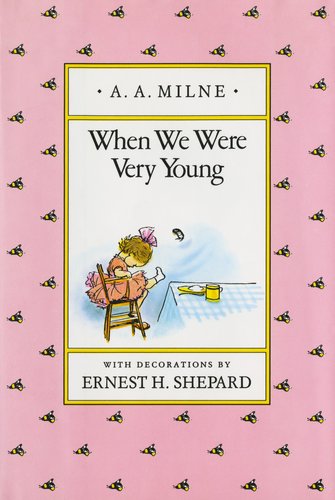
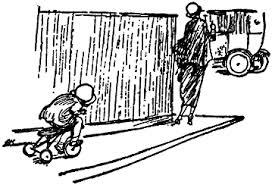 Disobedience is one of A.A. Milne’s most memorizable poems, and one of his best. He portrays the wonderful independence of a child’s mind and the natural audacity – James James goes immediately to the royals for help, in this case King John. Children reading the poem delight in the conceit – for children who are rarely in charge, it is a welcome relief to enter a world in which the mother is leashed to the tricycle rather than vice versa, and the mother is guilty of disobedience and suffers the consequences. It is a sign of Milne’s respect for children that there is no happy resolution – the mother is gone, for good. James James is not particularly sad about his loss, but simply disappointed that his mother failed to listen to him.









 100bookseverychildshouldreadbeforegrowingup